Grade 1 · Unit 1: Number and place value
Ordering numbers
Which number is bigger? Which comes first?
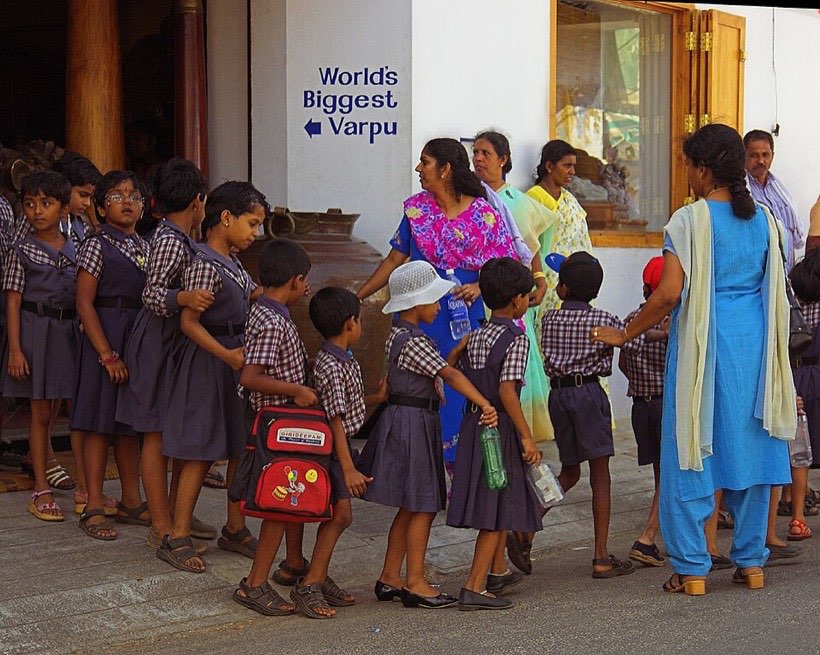
Lining up
We can put things in order: shortest to tallest, smallest to biggest. Numbers can be put in order too. A number line shows numbers in order.
Children lining up in a queue. Who is first?
On the number line
Numbers get bigger as you go right. 15 is to the right of 8, so 15 is bigger. Numbers to the left are smaller.
8 is to the left of 15, so 8 is less than 15.
Greater than and less than
We write 15 > 8. It means 15 is greater than 8. We write 8 < 15. It means 8 is less than 15. The open mouth of the sign always faces the bigger number.
The open side of the sign faces the bigger number.
Comparing tens first
To compare 2-digit numbers, look at the tens first. 52 has 5 tens. 48 has 4 tens. So 52 > 48. If the tens are the same, look at the ones.
To compare 52 and 48, look at the tens first: 5 tens beats 4 tens.
To order 31, 13, 30 and 3 from smallest to largest: 3, 13, 30, 31. Compare the tens, then the ones.
Ten more, ten less
Find 34 on the hundred square. Ten more is one row down: 44. Ten less is one row up: 24. Only the tens digit changes!
On a hundred square, 10 more is one row down.
Your turn: What is ten more than 57?
Key words
- greater than
- Bigger than. The sign is >.
- less than
- Smaller than. The sign is <.
- order
- Put in a line from smallest to biggest, or biggest to smallest.
- number line
- A line with numbers in order, equally spaced.
Activity: Human number line
You need: number cards (one for each child), a long space
- Each child takes a number card.
- Without talking, line up from smallest to biggest!
- Check: read the numbers out loud along the line.
- Now make the line biggest to smallest.
Think and talk
- How do you know which number is bigger?
- Why do we look at the tens first?
- Order the ages of people in your family.
What I learnt
- I can order numbers from smallest to largest.
- I can use the signs > and < to compare numbers.