Grade 5 · Unit 5: Using units of measurement
Mass
Decimal masses and problem solving.
Story time: Jute for export
A jute trader loads 20 bales onto a ship. Each bale weighs 180 kg. “What is the total in tonnes?” asked the captain. 20 × 180 = 3600 kg = 3.6 tonnes. “Jute is the golden fibre of Bangladesh,” the trader said proudly.
Shipping jute
Bangladesh exports jute in bales. Each bale might be about 180 kg. Ships carry thousands of tonnes.
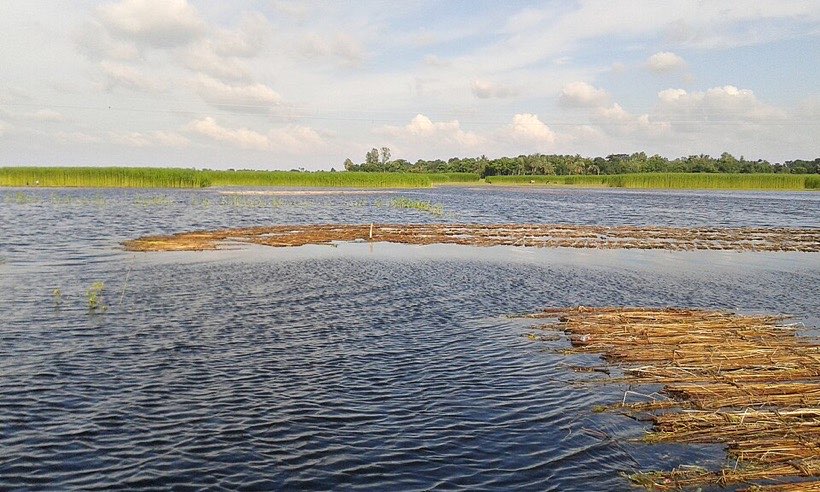
Jute plants beside a beel in Natore. Jute fibre is weighed and sold in bales.
Units of mass
1 g = 1000 mg; 1 kg = 1000 g; 1 t = 1000 kg. Medicine doses use milligrams. Ships and trucks use tonnes.
Choose a sensible unit.
Decimal masses
Read scales carefully between marks. 2.35 kg = 2 kg 350 g. Convert: × 1000 for grams.
The pumpkin has a mass of 2.35 kg = 2350 g.
Your turn: 4.75 kg = ? g
Problem solving
20 bales of 180 kg each = 3600 kg. 3600 kg = 3.6 tonnes. Always give the unit.
Multiply, then convert.
Worked example
- How many 250 g packets from 3 kg of tea?
- 3 kg = 3000 g.
- 3000 ÷ 250 = 12 packets.
Did you know? Jute is called the “golden fibre” of Bangladesh.
How accurate?
When the pointer is between marks, estimate: about 2.35 kg. A pharmacist must be very accurate – to the milligram. A farmer selling pumpkins can round to the nearest 100 g. Choose the accuracy the job needs.
The pointer is between two marks.
Key words
- tonne
- 1 t = 1000 kg.
- gram
- 1 kg = 1000 g.
- milligram
- 1 g = 1000 mg.
Meet the mathematician: Isaac Newton
1643–1727 · Woolsthorpe, England
Isaac Newton explained how gravity pulls things down to the ground. He showed that mass (how much matter) is different from weight (the pull of gravity). On the Moon your mass stays the same, but you would weigh much less. He also invented calculus and studied light.
Activity: Recipe scaling
You need: a recipe with masses
- A pitha recipe uses 500 g rice flour and 250 g jaggery for 10 pieces.
- Scale it for 30 pieces.
- Give answers in kg.
- Scale it for 5 pieces.
Think and talk
- What is measured in milligrams?
- How many 250 g packets make 2 kg?
- Why convert to tonnes for big masses?
What I learnt
- I can convert between mg, g, kg and t.
- I can solve mass problems with decimals.