Grade 5 · Unit 5: Using units of measurement
Volume and capacity
Cubic metres, litres and tanks.
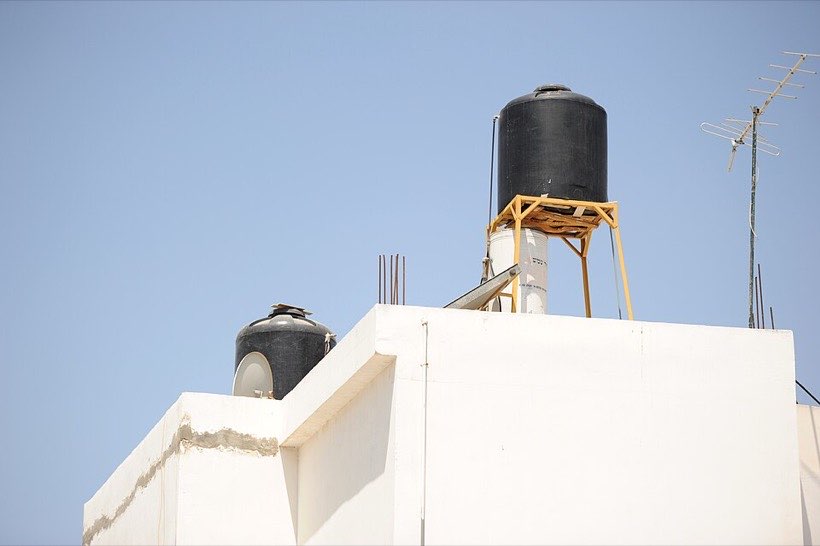
Story time: The rooftop tank
A family in Khulna bought a water tank 2 m long, 1.5 m wide and 1 m high. “How many litres?” asked Ayan. Volume = 2 × 1.5 × 1 = 3 m³. Each m³ holds 1000 litres: 3000 litres. The family uses 450 litres a day, so it lasts about 6 days.
Water tanks
A rooftop tank is 2 m long, 1 m wide and 1 m high. How much water can it hold? We need volume and capacity.
Water tanks on rooftops.
Volume of a cuboid
Volume = l × w × h. Tank: 2 × 1 × 1 = 2 m³. 1 m³ holds 1000 litres, so the tank holds 2000 litres.
V = length × width × height.
Your turn: Volume of a 6 cm × 5 cm × 4 cm box?
Units
1 cm³ = 1 ml. 1000 cm³ = 1 litre. 1 m³ = 1000 litres.
Linking volume and capacity.
Missing lengths
If you know the volume and two lengths, divide. 60 ÷ 15 = 4. The height is 4 cm.
Use the inverse to find a missing length.
Worked example
- A tank holds 72 litres = 72 000 cm³. It is 60 cm long and 40 cm wide.
- 60 × 40 = 2400 cm² base.
- 72 000 ÷ 2400 = 30 cm high.
Did you know? Dhaka city uses over 250 crore litres of water every day.
Key words
- volume
- Space taken up by a 3D shape.
- cubic metre
- A cube 1 m on each side (m³).
Meet the mathematician: Zu Chongzhi
429–500 · Jiankang, China
Zu Chongzhi was a Chinese mathematician and astronomer. He calculated π as between 3.1415926 and 3.1415927 – a record for nearly 1000 years. With his son, he found how to calculate the volume of a sphere. He also designed calendars and machines.
Activity: Displacement
You need: measuring jug, water, small stones
- Put 500 ml of water in a jug.
- Drop in a stone. Read the new level.
- The rise in ml = the stone’s volume in cm³.
- Try 3 different stones.
Think and talk
- How many litres in a 3 m³ tank?
- Two boxes have the same volume. Must they look the same?
- How would you find the volume of a stone?
What I learnt
- I can find the volume of cuboids.
- I can convert between cm³, ml, litres and m³.
- I can find missing lengths.