Grade 4 · Unit 5: Using units of measurement
Mass
Read scales and convert grams and kilograms.
Story time: Loading the boat
A cargo boat on the Meghna can carry 5 tonnes. Sacks of rice weigh 50 kg each. “How many sacks can it take?” asked the young boatman. 5 tonnes = 5000 kg, and 5000 ÷ 50 = 100 sacks.
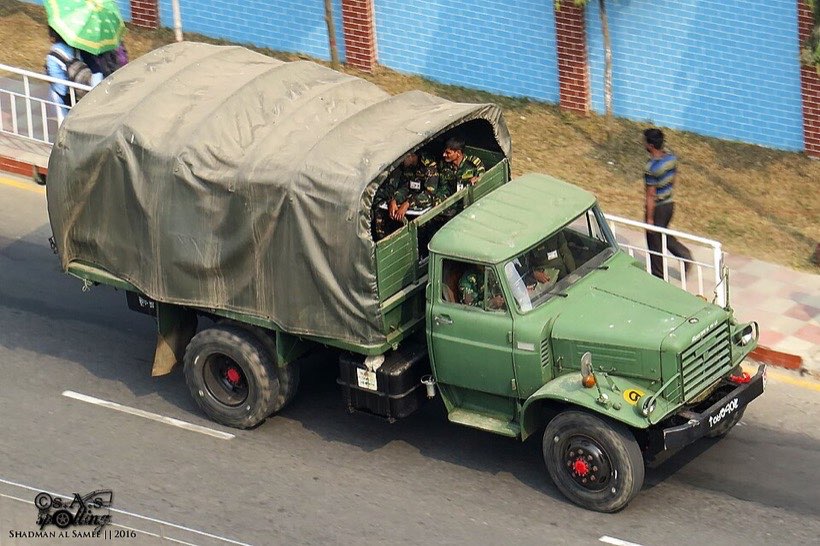
Loading a truck
A truck can carry 5 tonnes. 1 tonne = 1000 kg. Smaller things are measured in kg and g.
Trucks carry heavy loads measured in tonnes.
Reading scales
Find the scale interval: how much each mark is worth. Here, there are marks every 0.25 kg. The needle points to about 1.4 kg = 1400 g.
Work out what each small mark is worth.
Converting
Multiply kg by 1000 to get grams. Divide grams by 1000 to get kg. 750 g = 0.75 kg.
kg × 1000 = g
Worked example
- Change 3.25 kg to grams.
- 1 kg = 1000 g.
- 3.25 × 1000 = 3250 g.
Solving problems
The sack of onions is 5 times as heavy as the bag of rice. Total mass: 5 + 25 + 1 = 31 kg. In grams: 31 000 g.
Masses of shopping items.
Your turn: Which is heavier: 0.7 kg or 650 g?
Did you know? An adult Asian elephant can have a mass of about 4 tonnes.
Exact or estimate?
A measure can fall between two numbers: here 1.75 kg. A doctor needs an exact dose of medicine. A cook can estimate a pinch of salt. Choose the tool and unit that give the accuracy you need.
The pointer is three quarters of the way from 1 to 2: 1.75 kg.
Key words
- scale interval
- The value of each small step on a scale.
- tonne
- 1 tonne = 1000 kg.
Meet the mathematician: Al-Khazini
12th century · Merv (now Turkmenistan)
Al-Khazini was a scientist who studied balances and weighing. In 1121 he wrote “The Book of the Balance of Wisdom”. He described a very accurate balance for comparing the masses of metals and gems. His careful measurements helped traders and scientists for centuries.
Activity: Mass estimation challenge
You need: kitchen scales, 5 objects
- Estimate each object’s mass in grams.
- Weigh and record in g and kg.
- Find the total mass.
- Order the objects by mass.
Think and talk
- How do you find the value of each mark on a scale?
- Is 0.6 kg more or less than 550 g?
- What would you measure in tonnes?
What I learnt
- I can read scales with different intervals.
- I can convert between g, kg and tonnes.