Grade 4 · Unit 5: Using units of measurement
Area
Square centimetres and square metres.
Story time: Tiling the classroom
The school is tiling a classroom floor 9 m long and 7 m wide. Each tile covers 1 square metre. “Do we count every tile?” asked Mim. “No – 9 rows of 7: 63 tiles!” Tiles cost ৳350 each, so the floor costs 63 × ৳350 = ৳22 050.
Tiling a floor
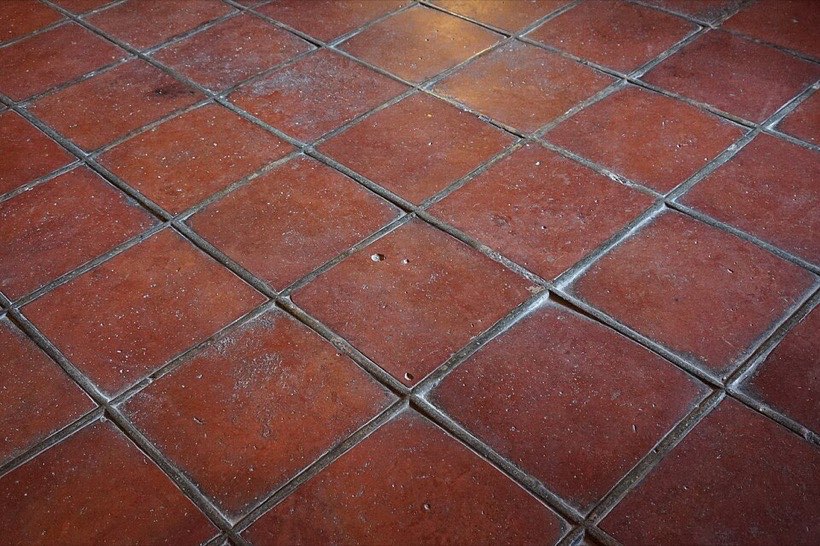
A floor is covered with square tiles. Counting tiles tells us the area. Area is measured in square units.
Square floor tiles.
Area of a rectangle
Count the rows and columns. Area = length × width. 7 × 4 = 28 cm².
4 rows of 7 = 28 square units.
Worked example
- A rectangle is 12 cm long and 5 cm wide.
- Area = length × width.
- 12 × 5 = 60 cm².
Rectilinear shapes
Split the shape into rectangles. Find each area: 5 × 2 = 10 and 2 × 2 = 4. Add: 14 square units.
Split the L-shape into two rectangles: 10 + 4 = 14 squares.
Same perimeter, different area
All these rectangles have a perimeter of 20. Their areas are different! The square (5 × 5) has the biggest area.
With the same perimeter, a square gives the biggest area.
Your turn: A square has area 49 cm². How long is each side?
Did you know? A cricket pitch is about 20 m by 3 m, an area of about 60 m².
Irregular areas
A lake or a leaf is not a rectangle. Count whole squares, then add up the half squares. Each square here is 1 cm²: the area is about 17 cm².
Count whole squares; join part squares.
Key words
- square centimetre
- A square 1 cm by 1 cm (cm²).
- square metre
- A square 1 m by 1 m (m²).
- formula
- A rule written with letters, like A = l × w.
Meet the mathematician: Georg Pick
1859–1942 · Vienna, Austria
Georg Pick was a mathematician who taught in Prague. In 1899 he found a surprising rule for shapes drawn on a grid of dots. Count the dots inside and the dots on the edge, and you can work out the area! His rule, “Pick’s theorem”, is a favourite puzzle for young mathematicians.
Activity: Biggest garden
You need: 20 cm string, squared paper
- Make rectangles with the string as the perimeter.
- Draw each on squared paper.
- Find each area.
- Which rectangle has the biggest area?
Think and talk
- Why is area measured in square units?
- What happens to the area of a rectangle if you double its length?
- Which shape gives the biggest garden for a fixed fence?
What I learnt
- I can find area with A = l × w.
- I can find areas of rectilinear shapes.
- I know perimeter and area are different.