Grade 4 · Unit 5: Using units of measurement
Length and perimeter
Convert units and find perimeters.
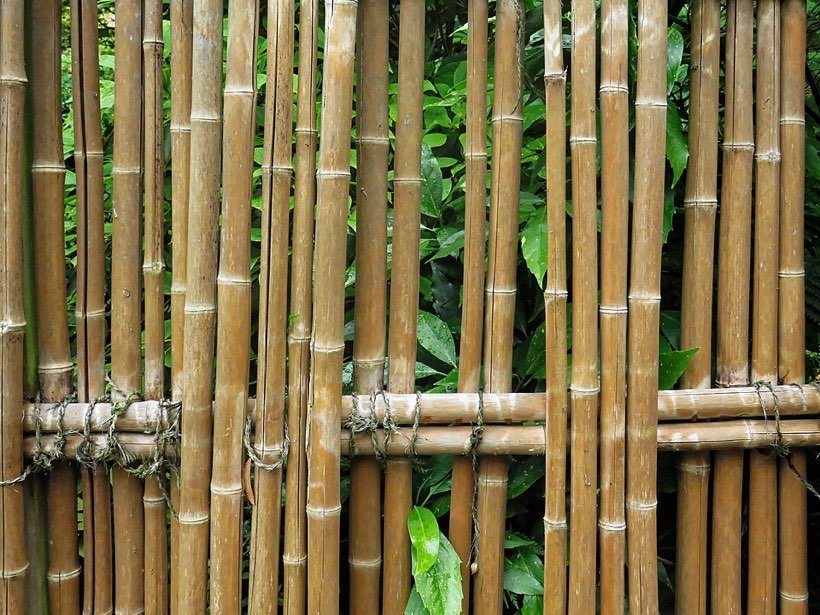
Story time: The bamboo fence
Grandfather wants a bamboo fence around his vegetable plot, 8 m long and 5 m wide. “How much bamboo?” asked Polash. 2 × (8 + 5) = 26 m. Bamboo costs ৳120 per metre, so the fence costs 26 × ৳120 = ৳3120.
Building a fence
A family wants a bamboo fence around their vegetable garden. They need to know the perimeter. They also need to convert between m and cm.
A bamboo fence around a home garden.
Converting units
To change to a smaller unit, multiply. 3.5 m = 350 cm. To change to a bigger unit, divide: 2500 m = 2.5 km.
10 mm = 1 cm, 100 cm = 1 m, 1000 m = 1 km.
Worked example
- Change 2.4 km to metres.
- 1 km = 1000 m.
- 2.4 × 1000 = 2400 m.
Perimeter of rectangles
Perimeter of a rectangle = 2 × (length + width). 2 × (6 + 3) = 18 m. The family needs 18 m of fence.
6 m by 3 m garden: perimeter = 2 × (6 + 3) = 18 m.
Rectilinear shapes
For an L-shape, work out any missing sides. Then add all the sides. This L-shape has perimeter 5 + 2 + 3 + 2 + 2 + 4 = 18 units.
An L-shape: find any missing side lengths first.
Your turn: A rectangle is 9 cm by 4 cm. What is its perimeter?
Did you know? The Padma Bridge is about 6.15 km long – that is 6150 m.
Decimals in measures
Measures are often written with decimals: 1.250 kg. To convert, multiply or divide by 10, 100 or 1000. Measure lines to the nearest millimetre: 4.6 cm = 46 mm.
Decimals make converting easy.
Key words
- convert
- Change from one unit to another.
- rectilinear
- A shape made of straight sides that meet at right angles.
Meet the mathematician: Pierre Méchain
1744–1804 · Laon, France
In the 1790s, France decided to create a new unit of length: the metre. Pierre Méchain and Jean-Baptiste Delambre measured the distance from Dunkirk to Barcelona. From that distance they worked out exactly how long a metre should be. Their 7-year survey gave the world a shared unit we still use.
Activity: Perimeter walk
You need: trundle wheel or measuring tape
- Estimate the perimeter of the classroom in metres.
- Measure each wall.
- Add to find the perimeter.
- Convert to centimetres.
Think and talk
- How do you find a missing side in an L-shape?
- Why do we multiply to convert to smaller units?
- Can two different shapes have the same perimeter?
What I learnt
- I can convert between mm, cm, m and km.
- I can find perimeters of rectangles and rectilinear shapes.