Decimals
A dot that lets numbers show parts.
Story time: The tailor’s tape
Rahima’s mother is a tailor in Mirpur. She measures a customer’s arm: “0.6 metres,” she says. “Point six? What does the dot mean?” asks Rahima. Her mother smiles. “It means six tenths of a metre – 60 centimetres. Let me show you.”
Parts of a whole
Not everything is a whole number. A ribbon can be 1 metre and a bit long. Decimals show the bits: 1.4 m means 1 whole metre and 4 tenths.
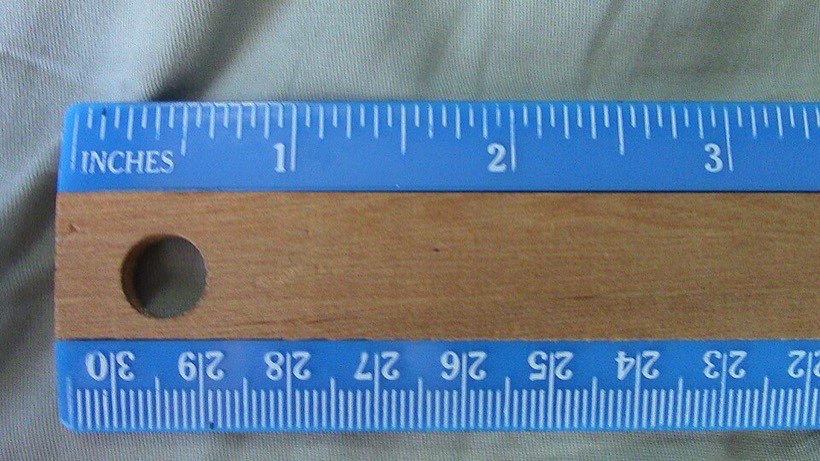
This ruler shows inches on top and centimetres below; each centimetre is split into 10 millimetres.
Tenths
Cut 1 whole into 10 equal parts: each part is a tenth, 0.1. 3 tenths is 0.3 = 3/10. The decimal point separates wholes and parts.
0.3 is three tenths; 0.7 is seven tenths.
Worked example
- Write 7/10 as a decimal.
- Seven tenths: 7 in the tenths place.
- 7/10 = 0.7.
Hundredths
Cut 1 into 100 parts: each is a hundredth, 0.01. 45 hundredths is 0.45 – 4 tenths and 5 hundredths. It is also 45/100, and 45%.
45 out of 100 squares: 0.45.
Comparing decimals
Compare the whole numbers first, then the tenths, then the hundredths. 2.38 < 2.5 because 3 tenths < 5 tenths. Order: 1.9, 2.38, 2.5, 3.05.
2.38 = 2 ones, 3 tenths, 8 hundredths.
Your turn: Which is bigger: 0.6 or 0.58?
Decimals in the shop
৳12.50 is 12 taka and 50 poisha. Add decimals by lining up the points: 12.50 + 5.25 = 17.75. Lengths too: 1.25 m is 1 m 25 cm.
Prices use two decimal places: taka and poisha.
Worked example
- Estimate first: ৳13 + ৳5 + ৳19 is about ৳37.
- Add exactly: 12.50 + 5.25 + 18.75 = 36.50.
- The total ৳36.50 is close to the estimate ✓.
Key words
- decimal
- A number with a decimal point, like 2.5.
- decimal point
- The dot between the whole number and the parts.
- tenth
- One of ten equal parts: 0.1.
- hundredth
- One of a hundred equal parts: 0.01.
Meet the mathematician: Simon Stevin
1548–1620 · Bruges, Flanders (now Belgium)
Simon Stevin was an engineer who worked with money, ships and canals. In 1585 he wrote a small book showing that tenths and hundredths make calculations much easier. He wanted everyone – shopkeepers, builders and farmers – to use them. Today’s decimal point grew from his ideas.
Activity: Decimal hunt
You need: shop receipts, tape measure, paper
- Find 5 decimals on receipts or labels.
- Measure 3 classmates’ arm spans in metres to 2 decimal places.
- Order all the numbers from smallest to biggest.
- Write each as a fraction too.
Think and talk
- Where do you see decimals in daily life?
- Is 0.5 the same as ½? How do you know?
- Why do prices have two decimal places?
What I learnt
- I can read and write tenths and hundredths.
- I can compare and order decimals.
- I can use decimals for money and length.