Grade 3 · Unit 1: Number and place value
Multiplying and dividing in your head
Use facts you know for bigger numbers.
Story time: The school concert chairs
For the school concert, chairs were set out in 30 rows of 8. “That is 240 chairs,” said the head teacher quickly. “How did you do that?” asked a learner. “3 × 8 = 24, so 30 × 8 = 240. Then 250 guests came – so 10 people had to stand!”
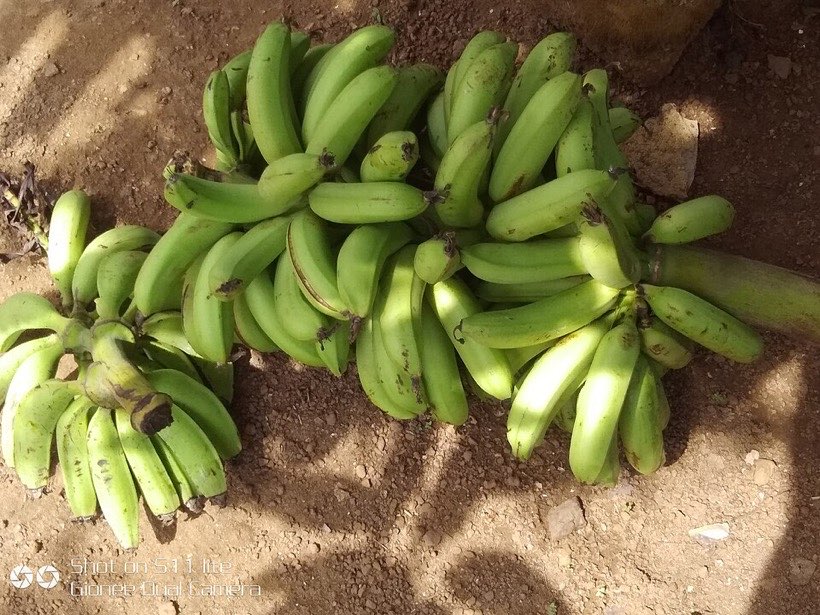
Crates of bananas
A trader has 30 crates with 4 bunches in each. How many bunches? Use 3 × 4 = 12, so 30 × 4 = 120.
Bananas packed for market.
Multiplying by 10 and 100
When we multiply by 10, each digit moves one place to the left. A zero holds the ones place. × 100 moves digits two places: 23 × 100 = 2300.
234 × 10 = 2340: every digit moves one place left.
Worked example
- 56 × 100: each digit moves two places to the left.
- 5 tens become 5 thousands; 6 ones become 6 hundreds.
- 56 × 100 = 5600.
Related facts
If you know 6 × 4 = 24, then 60 × 4 = 240. And 240 ÷ 4 = 60. These are related facts.
One fact gives many more.
Remainders
Not all numbers divide exactly. 14 ÷ 4 = 3 with 2 left over. We write 14 ÷ 4 = 3 r 2. The 2 is the remainder.
14 mangoes into 4 bags: 3 each, 2 left over.
Your turn: 47 learners travel in cars of 5. How many cars are needed?
Did you know? Remainders matter: 14 children in cars of 4 need 4 cars, not 3!
Group to make it easy
When you multiply three numbers, group any two first. 2 × 5 = 10, then 10 × 7 = 70. This is the associative property – it makes multiplying quicker.
You can group the numbers in any way when multiplying.
Key words
- multiply by 10
- Each digit moves one place to the left: 23 × 10 = 230.
- related fact
- A fact you can work out from one you know.
Meet the mathematician: Srinivasa Ramanujan
1887–1920 · Erode, India
Ramanujan taught himself maths from a library book as a teenager. He found amazing patterns in numbers and filled notebooks with new ideas. Once a friend said his taxi number, 1729, was dull. Ramanujan replied that it is the smallest number that is the sum of two cubes in two different ways! Mathematicians still study his notebooks today.
Activity: Remainder race
You need: a dice, counters
- Take a handful of counters and count them.
- Roll the dice to choose the group size.
- Share into groups. Record the remainder.
- The player with the biggest remainder scores a point.
Think and talk
- Why does × 10 add a zero?
- How does 7 × 8 help with 70 × 8?
- When would you round a remainder up?
What I learnt
- I can multiply by 10 and 100.
- I can use related facts.
- I can divide with remainders.