Grade 5 · Unit 4: The way we see things
Seeing behind you
Use mirrors to see round corners and over walls.
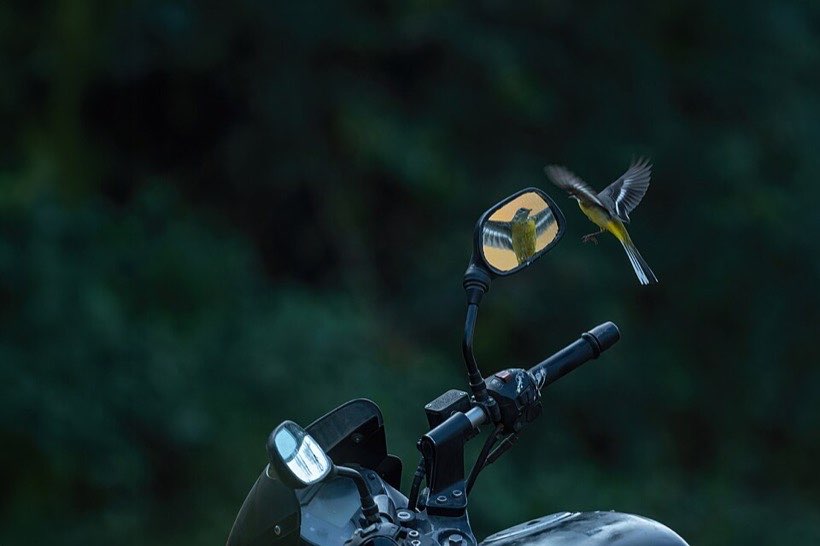
Looking behind
Drivers and riders use mirrors to see behind them without turning round. Light from the cars behind reflects off the mirror into the driver’s eyes. This is a rear-view mirror.
Motorbike mirrors show the rider what is behind.
Motorcycle mirrors are slightly curved outwards so that the rider sees more of the road behind.
Periscopes
A periscope is a tube with two mirrors at each end, set at an angle. Light enters at the top, reflects off the first mirror down the tube, then off the second mirror into your eye. Submarines use periscopes to see above the water.
Looking through a periscope, which uses mirrors to see over things.
Periscopes were used in submarines and in trenches, so people could look out without being seen.
Mirrors at bends
On narrow hill roads and in car parks there are big round mirrors at bends. They are convex mirrors – they curve outwards. They show a wide view, so drivers can see cars coming round the corner.
A round mirror at a bend on a hill road shows traffic coming.
Convex mirrors make things look smaller and further away, so drivers must still drive slowly at bends.
At the dentist
A dentist uses a small mirror on a handle to see the backs of your teeth. Hairdressers hold a mirror behind you so you can see the back of your head.
A dentist’s small mirror shows the backs of the teeth.
A dentist’s mirror is warmed or coated so that your warm breath does not mist it up.
Did you know? Shop security mirrors are convex, so staff can see the whole shop.
Key words
- periscope
- A tube with two mirrors used to see over or around things.
- convex mirror
- A mirror that curves outwards and shows a wide view.
- rear-view mirror
- A mirror in a vehicle that shows what is behind.
Activity: Build a periscope
You need: a long juice carton, two small mirrors, scissors, tape, a protractor
- Cut a square window near the top on one side and near the bottom on the other side.
- Fix one mirror at 45° at the top, facing down.
- Fix the other mirror at 45° at the bottom, facing up.
- Look through the bottom window. Can you see over a desk?
- Draw the path of light through your periscope.
Think and talk
- How does a periscope let you see over a wall?
- Why are mirrors at road bends curved?
- Where else could mirrors help people see behind them?
What I learnt
- I can explain how mirrors help us see behind us and round corners.
- I can build a periscope and draw the path of light through it.