Grade 5 · Unit 4: The way we see things
Mirrors
Mirrors bounce light in a neat, predictable way.
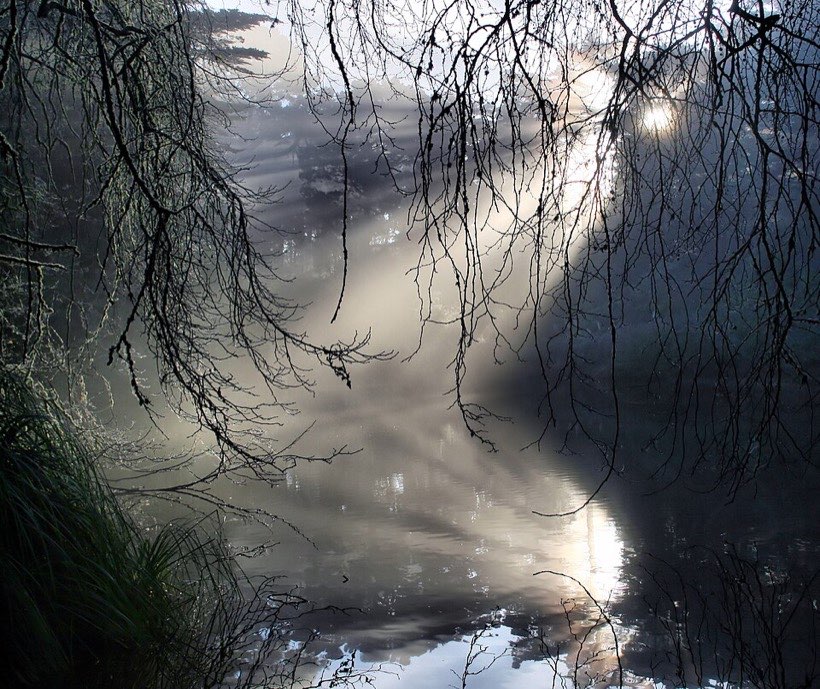
Clear reflections
A mirror is very smooth and shiny. It reflects light so neatly that we see a clear image. Still water and polished metal can work like mirrors too.
A still lake reflects the trees like a mirror.
A mirror image is the same size as you and appears to be as far behind the mirror as you are in front of it.
Back to front
Raise your right hand in front of a mirror. Your image raises its left hand! Writing looks back to front in a mirror. That is why “AMBULANCE” is written backwards on the front of ambulances – drivers ahead read it the right way in their mirrors.
Writing looks back to front in a mirror.
Hold a written word up to a mirror and look at its reflection in a second mirror – it reads the right way round again!
The bouncing rule
Light bounces off a mirror like a ball bouncing off a wall. The angle the light comes in at equals the angle it bounces off at. This rule lets us predict where the light will go.
Shine a ray at a mirror in the Bending Light lab and measure the angles.
This rule – the angle in equals the angle out – is called the law of reflection.
Mirrors in daily life
We use mirrors for getting ready, in cars and buses, and in telescopes. Dentists use small mirrors to see the backs of teeth.
Car mirrors help drivers see what is behind them.
Telescopes in big observatories use huge curved mirrors to collect faint light from distant stars.
Did you know? Astronauts left mirrors on the Moon. Scientists bounce laser light off them to measure the distance to the Moon very accurately.
Key words
- mirror
- A very smooth, shiny surface that reflects light clearly.
- reflection
- Light bouncing off a surface, or the image you see in a mirror.
- image
- The picture you see in a mirror.
- angle
- The amount of turn between two lines.
Activity: Mirror writing
You need: a small mirror, paper and pencil
- Write your name normally. Look at it in the mirror. What happens?
- Try to write your name so it reads correctly in the mirror.
- Find capital letters that look the same in a mirror (like A, H, M, O, T).
- Write a secret mirror message for a friend.
Think and talk
- Why is “AMBULANCE” written backwards on the front of ambulances?
- Can you write your name so that it reads correctly in a mirror?
- Where are mirrors used to keep people safe?
What I learnt
- I know that mirrors reflect light to make a clear image.
- I know that mirror images are reversed left to right.