Grade 5 · Unit 2: The life cycle of flowering plants
Investigating pollination
Which flowers do insects like best?
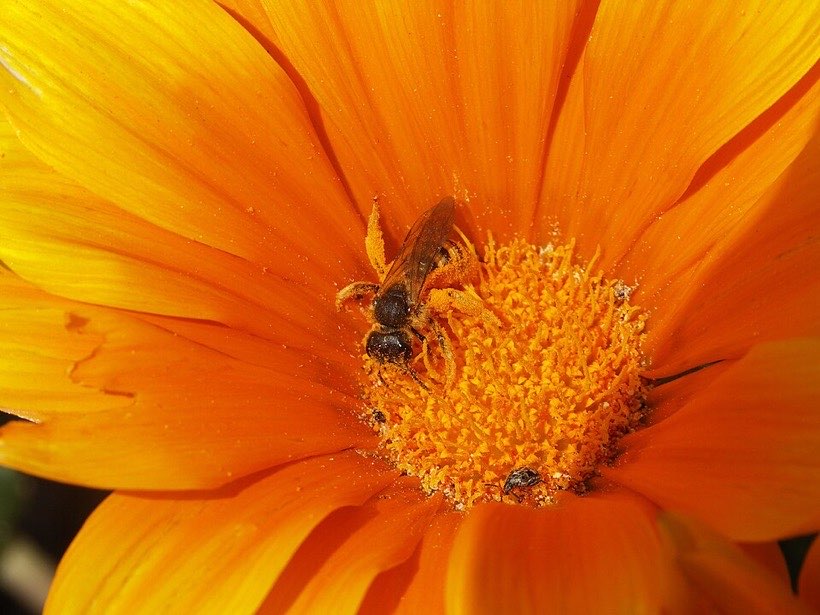
Asking a question
Scientists ask questions about pollination. Do bees prefer blue or yellow flowers? Do more insects visit in the morning or afternoon? We can answer these questions with careful observation.
Do bees prefer some colours of flower?
A good scientific question can be tested with an investigation and answered with measurements.
Paper flower test
Make paper flowers of different colours with a drop of sugar water in the middle. Put them in the garden and count the insects that visit each colour. Keep everything the same except the colour.
Paper flowers of different colours with a drop of sugar water.
Using paper flowers lets you change just the colour. Real flowers also differ in scent, size and nectar, which would make the test unfair.
Pollinating by hand
Some farmers in Bangladesh pollinate pumpkin and gourd flowers by hand. They use a brush or a male flower to move pollen to the female flower. This is called hand pollination. It gives more fruits when there are few insects.
A small brush loaded with pollen – the tool for hand pollination.
Vanilla flowers are pollinated by hand on farms around the world, because their natural pollinator, a kind of bee, lives only in Mexico.
Finding patterns
Put your results in a table, then a bar chart. Look for a pattern: “More insects visited yellow flowers than blue ones.” Use evidence from your results in your conclusion.
A bar chart of insect visits makes patterns easy to spot.
Bar charts are good for comparing separate groups, like flower colours. Line graphs are better for showing change over time.
Did you know? Bees can see ultraviolet light. Many flowers have patterns that only bees can see, showing the way to the nectar.
Key words
- observation
- Watching carefully and recording what you see.
- hand pollination
- Moving pollen by hand with a brush.
- pattern
- Something that happens again and again in results.
Activity: Colour test
You need: paper flowers in 4 colours (same size), sugar water, sticks, a stopwatch
- Predict which colour will get the most visitors.
- Put the flowers in a sunny garden, 1 metre apart.
- Count insect visits to each flower in 15 minutes.
- Repeat on another day.
- Draw a bar chart and write a conclusion.
Think and talk
- Why should the paper flowers all have the same amount of sugar water?
- Why do farmers hand-pollinate gourds?
- What other question about pollination could you test?
What I learnt
- I can plan an investigation about pollination.
- I can find patterns in results and use them as evidence.