Grade 5 · Unit 8: Location and transformation
Symmetry
Line and rotational symmetry together.
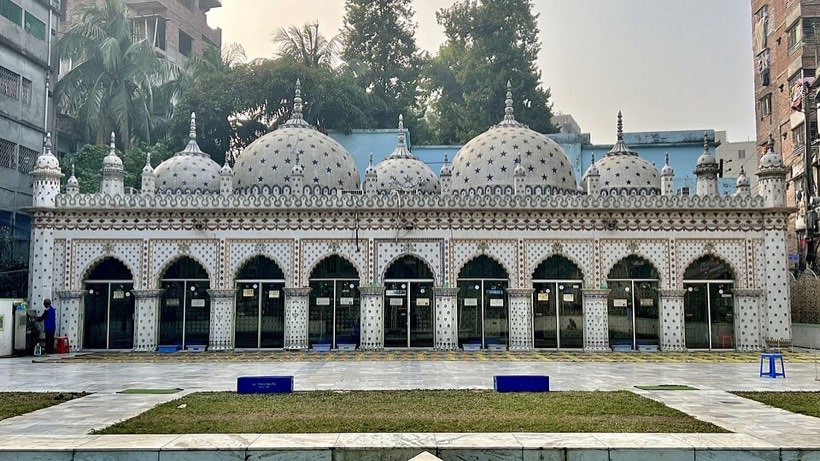
Story time: The Star Mosque
On a trip to Old Dhaka, the class visited the Star Mosque. Its walls are covered in star patterns made of small tiles. “This star has 6 lines of symmetry and looks the same after every sixth of a turn,” said their guide. The learners sketched their favourite patterns to copy in class.
Symmetry in architecture
Architects use symmetry for balance and beauty. Many buildings have a line of symmetry down the middle. Domes and windows often have rotational symmetry.
Many mosques and monuments are symmetrical.
Both kinds
This star has 5 lines of symmetry. It also has rotational symmetry of order 5. Regular polygons have both.
A five-pointed star: 5 lines and order 5.
Your turn: Order of rotational symmetry of a regular pentagon?
Comparing shapes
A parallelogram has no lines of symmetry but order 2. A kite has 1 line but order 1 (no rotational symmetry). Check each separately.
Line and rotational symmetry do not always match.
Worked example
- Parallelogram: try folding along any line – the halves never match.
- Turn it half a turn – it fits on itself.
- So it has 0 lines of symmetry and order 2.
Designing with symmetry
Start with a quarter of a design. Reflect it twice for 2 lines of symmetry. Or rotate it for rotational symmetry.
Designs can be built using symmetry.
Did you know? Snowflakes have 6 lines of symmetry and rotational symmetry of order 6.
Tessellations
Shapes tessellate when their angles fit around a point to make 360°. Six triangles (6 × 60°), four squares (4 × 90°) or three hexagons (3 × 120°) meet at a point. A regular pentagon (108°) cannot: 3 × 10⁸° = 324°, leaving a gap.
These regular shapes tessellate on their own.
Key words
- line symmetry
- A shape folds onto itself along a line.
- rotational symmetry
- A shape looks the same after part of a turn.
- order
- The number of times a shape fits onto itself in a full turn.
Meet the mathematician: Évariste Galois
1811–1832 · Bourg-la-Reine, France
Évariste Galois was a brilliant young French mathematician. He studied the symmetries hidden inside equations. His ideas created a new branch of maths called group theory, which is the mathematics of symmetry. Sadly he died at only 20, but his ideas changed mathematics for ever.
Activity: Alpana design
You need: squared paper, compass, colours
- Design an alpana with rotational symmetry of order 4.
- Add 4 lines of symmetry too.
- Swap with a partner and check.
- Display the designs.
Think and talk
- Find a shape with rotational symmetry but no lines of symmetry.
- What is the order of rotational symmetry of the letter S?
- Is order 1 really “symmetry”?
What I learnt
- I can find lines of symmetry and the order of rotational symmetry.
- I can design symmetrical patterns.