Grade 5 · Unit 8: Location and transformation
Transformations
Translate, reflect, rotate.
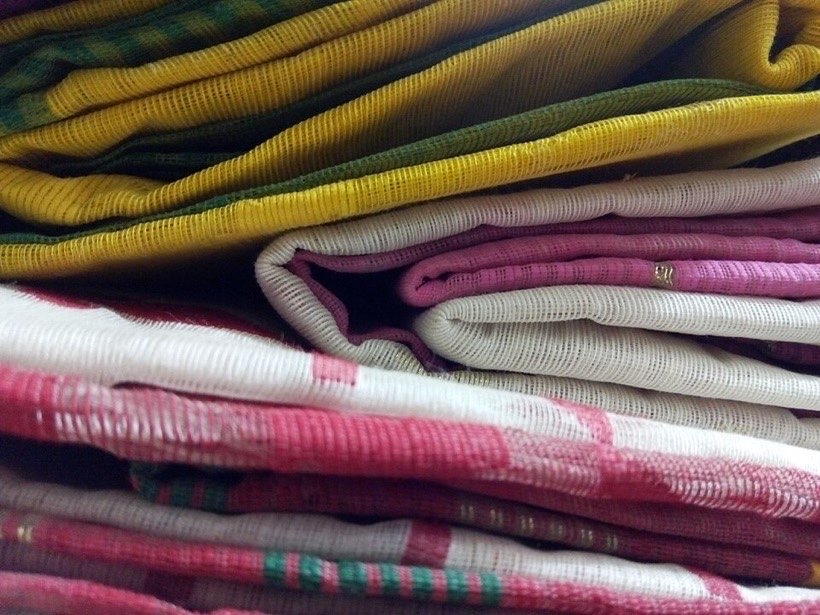
Story time: The jamdani weaver
In Rupganj, a jamdani weaver creates a flower motif. She slides it along to repeat it, flips it to make a mirror pair, and turns it for the corners. “Slide, flip, turn,” she tells her granddaughter. Three transformations make one of the most beautiful fabrics in the world.
Patterns in textiles
Jamdani weavers repeat motifs across the cloth. They slide, flip and turn the designs. These are transformations: translation, reflection and rotation.
Jamdani sarees use repeated and reflected motifs.
Translation
Every point moves the same way. Describe it: 5 right, 3 up. The image is congruent to the object.
Translate 5 right and 3 up.
Worked example
- Translate (3, 2) by 4 right and 3 up.
- x: 3 + 4 = 7. y: 2 + 3 = 5.
- The image is (7, 5).
Reflection
A reflection flips the shape over a mirror line. Points are the same distance from the line on both sides. The shape faces the other way.
Each point is the same distance from the mirror line.
Rotation
A rotation turns a shape about a point. Say the angle (90°, 180°), the direction, and the centre. Tracing paper helps you rotate accurately.
Describe the angle, direction and centre.
Your turn: What do you need to describe a rotation?
Did you know? In all three transformations, the shape stays congruent.
Key words
- translation
- A slide; describe it as right/left and up/down.
- rotation
- A turn about a centre, by an angle and direction.
- congruent
- Exactly the same shape and size.
Meet the mathematician: Felix Klein
1849–1925 · Düsseldorf, Germany
Felix Klein had a big idea in 1872: geometry is the study of what stays the same when shapes are moved. Slides, flips and turns keep size and shape the same. Enlargements keep the shape but change the size. He also invented the Klein bottle, a strange surface with only one side!
Activity: Jamdani design
You need: squared paper, tracing paper, colours
- Draw a small motif.
- Translate it to make a row.
- Reflect the row in a mirror line.
- Rotate the motif 90° to make a corner design.
Think and talk
- How is a reflection different from a rotation of 180°?
- Describe a translation from your seat to the door.
- Which transformation makes the shape face a new way?
What I learnt
- I can translate, reflect and rotate shapes.
- I can describe transformations precisely.