Grade 4 · Unit 2: Fractions and decimals
Mixed numbers and improper fractions
More than one whole.
Story time: The roti count
Mother cut each roti into quarters for the family dinner. Everyone ate: 11 quarters disappeared! “How many whole rotis is that?” asked Father. Shimu worked it out: 8 quarters make 2 rotis, and 3 quarters are left. “2¾ rotis!”
Rotis for a family
Each roti is cut into quarters. A family eats 7 quarters. That is more than one whole roti!
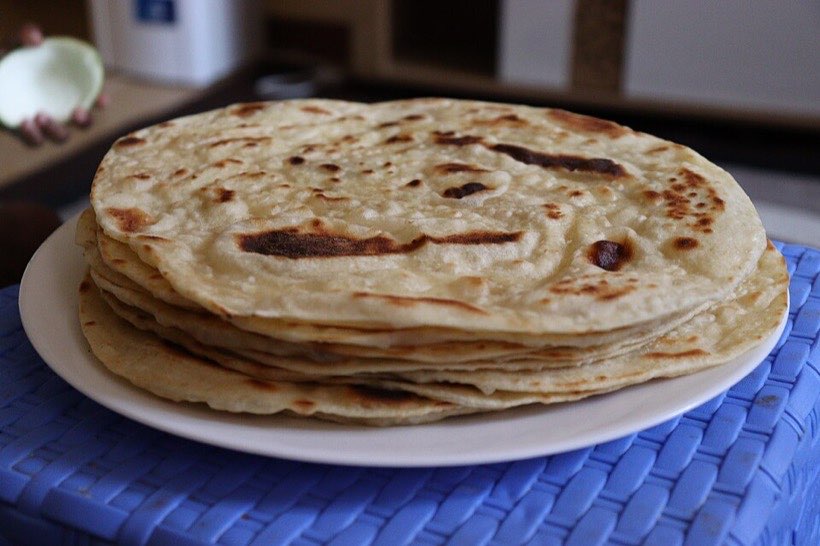
Rotis cooked for a family meal.
7 quarters
7/4 is an improper fraction. 4 quarters make 1 whole, and 3 quarters are left. So 7/4 = 1¾, a mixed number.
7/4 = 1¾
Your turn: Write 11/4 as a mixed number.
On a number line
Count in quarters: ¼, 2/4, 3/4, 1, 1¼ … 7/4 is at 1¾. 10/4 is at 2½.
1¾ (7/4) and 2½ (10/4).
Converting
Improper to mixed: divide numerator by denominator. Mixed to improper: multiply the whole by the denominator, add the numerator. Check with a drawing.
Divide to get a mixed number; multiply and add to get an improper fraction.
Worked example
- Change 3⅖ into an improper fraction.
- 3 wholes = 15 fifths.
- 15 fifths + 2 fifths = 17/5.
Did you know? Recipes often use mixed numbers, like 1½ cups of rice.
Key words
- improper fraction
- A fraction whose numerator is bigger than or equal to its denominator, like 7/4.
- convert
- Change from one form to another.
Meet the mathematician: Ahmes
about 1650 BCE · Egypt
Ahmes was a scribe who copied the Rhind papyrus, one of the oldest maths books we have. Egyptians wrote most fractions as sums of unit fractions, like ½ + ¼ for ¾. They used mixed numbers when sharing bread, beer and grain among workers. The papyrus is now in the British Museum in London.
Activity: Paper plate fractions
You need: paper plates cut into halves, thirds and quarters
- Take 9 quarter pieces.
- Make as many whole plates as you can.
- Write as an improper fraction and a mixed number.
- Try with thirds.
Think and talk
- Why is 7/4 called improper?
- Which is bigger: 9/4 or 2⅓?
- Where do you see mixed numbers in real life?
What I learnt
- I can convert between mixed numbers and improper fractions.
- I can place them on a number line.