Grade 3 · Unit 8: Location and transformation
Grids and maps
Find places using grid references.
Story time: The treasure map
Raihan found a treasure map in an old book. “The treasure is in square D4,” it said. He counted along the letters to D and up the numbers to 4. Under the big mango tree in D4 was a box of sweets left by his grandfather!
City maps
Maps of cities have grids. Each square has a grid reference. This helps you find places quickly.
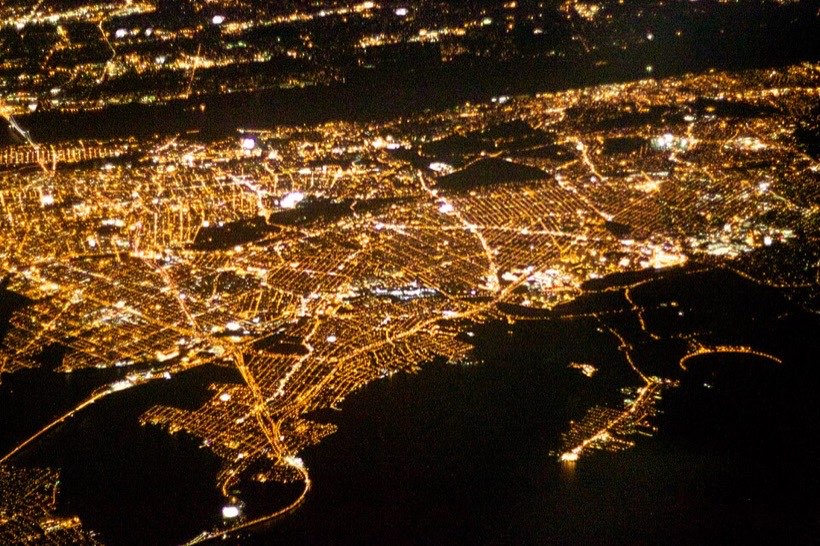
A city seen from above. Streets make a kind of grid.
Grid references
Read the letter along the bottom first, then the number up the side. The hospital is in square C3. “Along the corridor, then up the stairs.”
The hospital is in C3; the school is in E4.
Your turn: On the map, what is in square F2?
Compass directions
North, East, South, West. In between: north-east, south-east, south-west, north-west. From the hospital, the school is north-east.
An eight-point compass.
Following routes
Describe routes with directions and distances. East 3, north 3, east 1. Can you find a shorter route?
From A1 go east 3 squares, north 3 squares, then east 1.
Worked example
- Start at A1. Go east 3 squares → D1.
- Go north 3 squares → D4.
- Go east 1 square → E4, the school.
Did you know? Satellite navigation in phones uses coordinates that work like grid references.
Coordinates
Coordinates are two numbers in brackets: (across, up). A is 2 across and 3 up: (2, 3). Always go across first, then up – “along the corridor, then up the stairs”.
A is at (2, 3). B is at (5, 1).
Key words
- grid reference
- A letter and number that name a square on a grid, e.g. C3.
- compass
- Shows north, south, east and west.
Meet the mathematician: Muhammad al-Idrisi
1100–1165 · Ceuta (North Africa)
Al-Idrisi was a geographer and mapmaker. In 1154 he made a huge map of the world for King Roger of Sicily. He collected information from travellers, sailors and merchants. For hundreds of years it was one of the most accurate world maps.
Activity: Treasure map
You need: squared paper, colours
- Draw a 6 × 6 grid with letters and numbers.
- Add places and a hidden treasure.
- Give a partner clues using grid references and directions.
- Can they find the treasure?
Think and talk
- Why read the letter before the number?
- What is south-west of our classroom?
- Describe a route on the map to a partner.
What I learnt
- I can use grid references.
- I can use eight compass directions.
- I can describe routes.