Grade 3 · Unit 5: Using units of measurement
Volume and capacity
How much space does it take? How much does it hold?
Story time: The overflowing bucket
Arif filled a bucket to the brim with water. He dropped in a big stone. Splash! Water spilled over the side. “The stone pushed the water out,” said his sister. “It took up space.” The space a thing takes up is its volume.
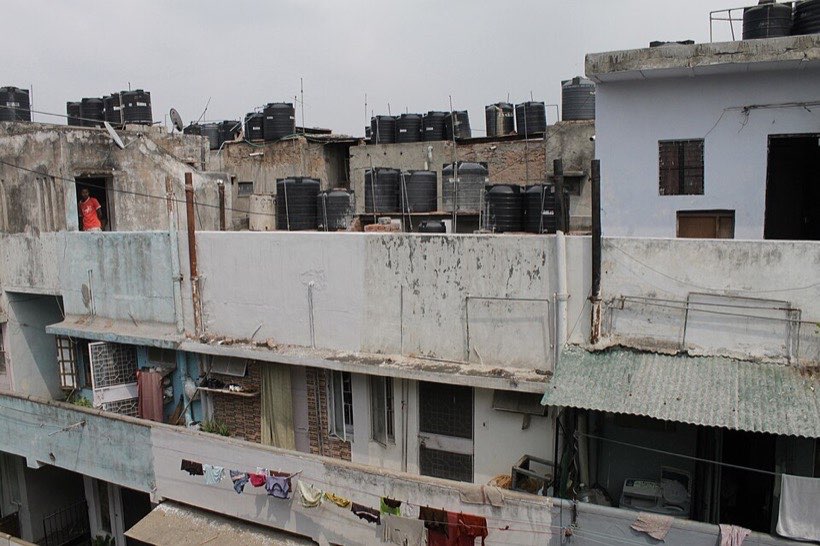
Water tanks
A rooftop tank holds 1000 litres of water. That is its capacity. The space the tank takes up is its volume.
Rooftop water tanks store water for a building.
Counting cubes
Build shapes with cubes. Count the cubes to find the volume. 4 long, 2 wide, 2 high = 16 cubic units.
This cuboid is made of 16 cubes.
Worked example
- A box is 5 cubes long, 2 wide and 3 high.
- One layer: 5 × 2 = 10 cubes.
- 3 layers: 30 cubes.
Reading scales
This jug shows 1500 ml. 1000 ml = 1 litre, so 1500 ml = 1½ litres. Read the scale at eye level.
The jug holds 1500 ml = 1½ litres.
Choosing units
Use millilitres for small amounts. Use litres for big amounts. A teaspoon holds about 5 ml.
Small amounts in ml, larger amounts in l.
Your turn: How many 250 ml cups fill a 2-litre bottle?
Did you know? A person needs about 2 litres of water a day in hot weather.
Key words
- volume
- How much space a solid object takes up.
- cubic unit
- A small cube used to measure volume.
- litre
- 1 l = 1000 ml.
Meet the mathematician: Archimedes
about 287–212 BCE · Syracuse, Sicily
Archimedes was one of the greatest mathematicians of all time. A famous story says he noticed the water rise when he got into his bath. He realised that an object pushes away water equal to its own volume, and shouted “Eureka!” – “I have found it!” He also invented machines, like a screw for lifting water.
Activity: Cube builders
You need: interlocking cubes
- Build a cuboid with 12 cubes.
- Build a different cuboid with 12 cubes.
- Do they have the same volume? Do they look the same?
- Record length, width and height.
Think and talk
- What is the difference between volume and capacity?
- How many 250 ml cups fill a 1 litre bottle?
- Build two different shapes with 12 cubes.
What I learnt
- I can find volume by counting cubes.
- I can read capacity in ml and l.