Grade 3 · Unit 5: Using units of measurement
Length, perimeter and area
Around the edge or covering the inside?
Story time: The football field
The school is painting lines on its football field. It is 60 m long and 40 m wide. “How far is it all the way round?” asks the caretaker. 60 + 40 + 60 + 40 = 200 metres of paint line! And the grass inside covers 60 × 40 = 2400 square metres.
Fencing a field
A farmer walks around the edge of a field. The distance around is the perimeter. The ground inside is the area.
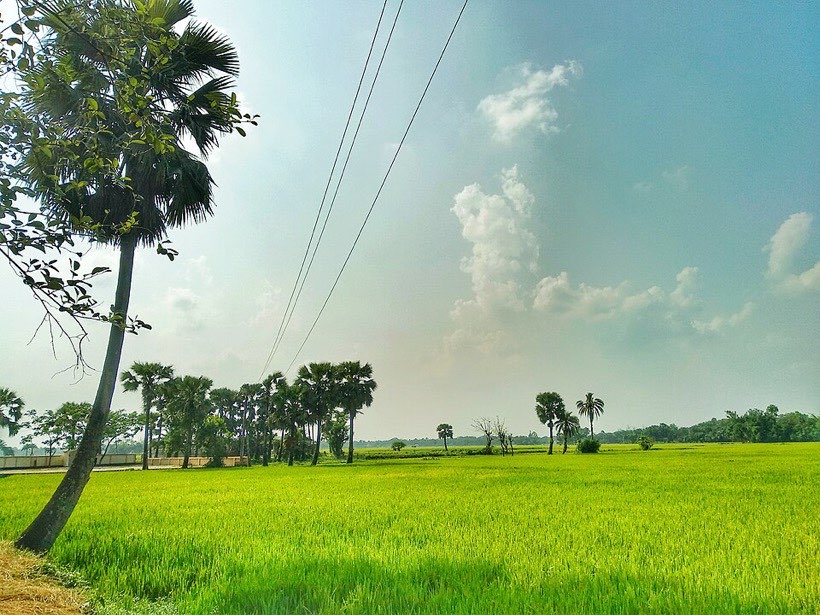
Paddy fields are separated by raised earth borders.
Units of length
Choose the unit that fits the size. A millimetre is tiny; a kilometre is long. The Padma Bridge is about 6 km long.
10 mm = 1 cm, 100 cm = 1 m, 1000 m = 1 km.
Perimeter
Add all the sides. 5 + 3 + 5 + 3 = 16 units. Or: 2 × (5 + 3) = 16.
A 5 × 3 rectangle: perimeter = 5 + 3 + 5 + 3 = 16 units.
Worked example
- A rectangle is 8 cm long and 5 cm wide.
- Perimeter = 8 + 5 + 8 + 5.
- = 26 cm.
Area
Count squares, or multiply rows by columns. 3 × 5 = 15 square units. Perimeter is a length; area is a number of squares.
The same rectangle: area = 3 rows of 5 = 15 squares.
Your turn: A rug is 4 m by 3 m. What is its area?
Did you know? Two shapes can have the same perimeter but different areas.
Millimetres and decimals
Each centimetre has 10 small marks: millimetres. 7 cm and 5 mm is 7.5 cm, or 75 mm. Lengths can be written with decimals: 1.5 m = 1 m 50 cm = 150 cm.
This crayon is 7.5 cm = 75 mm long.
Key words
- millimetre
- A tiny unit of length (mm). 10 mm = 1 cm.
- kilometre
- A long unit of length (km). 1 km = 1000 m.
Meet the mathematician: Gabriel Mouton
1618–1694 · Lyon, France
Gabriel Mouton was a priest who loved astronomy and maths. In 1670 he suggested a new set of measures based on tens – a bit like today’s metres, centimetres and millimetres. About 120 years later France created the metric system. Now most of the world measures in metres, including Bangladesh.
Activity: Rectangle investigation
You need: squared paper
- Draw as many rectangles as you can with an area of 12 squares.
- Find the perimeter of each.
- Which has the longest perimeter? The shortest?
- What do you notice?
Think and talk
- When would you need to know a perimeter? An area?
- Can two rectangles have the same area but different perimeters?
- Which unit for the length of a river?
What I learnt
- I can choose mm, cm, m or km.
- I can find perimeter.
- I can find area by counting or multiplying.