Grade 3 · Unit 1: Number and place value
Thousands
What happens after 999?
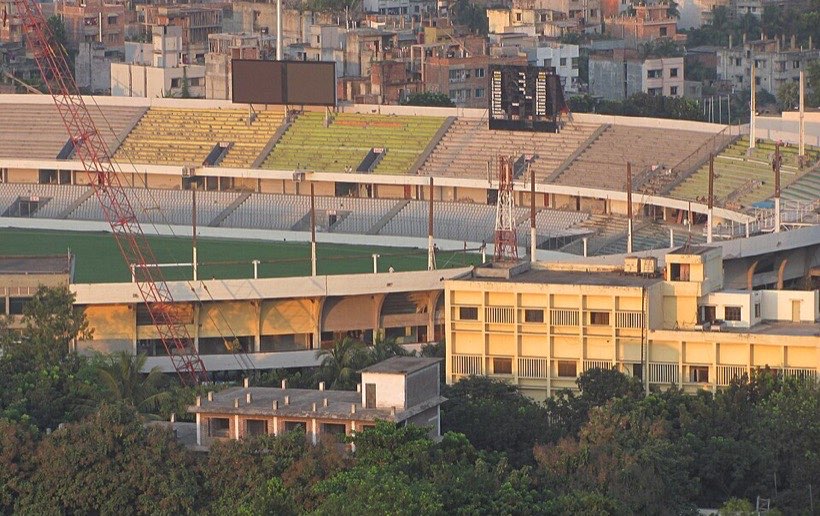
Story time: The cricket crowd
Shuvo went with his father to watch Bangladesh play cricket in Mirpur. The big screen said: “Today’s crowd: 24 685”. “How do you even say that number?” asked Shuvo. His father pointed at each digit: “Twenty-four thousand, six hundred and eighty-five. Every digit has its own job.”
Big crowds
A cricket stadium can hold more than 25 000 people. To count such big numbers we need thousands. After 999 comes 1000: one thousand.
A stadium can hold thousands of people.
Thousands, hundreds, tens and ones
10 hundreds make 1 thousand. This shows 2 thousands, 3 hundreds, 4 tens and 5 ones. We write 2345 and say “two thousand, three hundred and forty-five”.
2 thousands, 3 hundreds, 4 tens and 5 ones = 2345.
Place value to 10 000
Each place is worth 10 times the place on its right. In 7052: 7 thousands, 0 hundreds, 5 tens, 2 ones. 7052 = 7000 + 50 + 2.
In 7052 the 7 is worth 7000 and the 0 holds the hundreds place.
Worked example
- What is the 6 worth in 7652?
- Read the places from the right: ones, tens, hundreds, thousands.
- The 6 is in the hundreds place, so it is worth 600.
Comparing and rounding
To compare, look at the biggest place first: 4120 > 3980 because 4 thousands > 3 thousands. To round 3480 to the nearest hundred, look at the tens: 8 → round up to 3500. To the nearest thousand, look at the hundreds: 4 → round down to 3000.
3480 rounds to 3500 (nearest hundred) and to 3000 (nearest thousand).
Your turn: Round 4562 to the nearest thousand and to the nearest hundred.
Did you know? Dhaka has more than 10 000 000 people – ten million!
Ten thousands and beyond
After 9999 comes 10 000 – ten thousand. 45 708 has five digits. The 4 is worth 40 000. Bangladesh’s biggest stadium holds about 25 000 people – a 5-digit number.
45 708: 4 ten thousands, 5 thousands, 7 hundreds, 0 tens, 8 ones.
Below zero
A thermometer can go below 0 °C on a cold mountain. Numbers below zero are negative: −1, −2, −3 … −4 is colder than 2. On a number line, numbers get smaller to the left.
−4 is less than 6. Numbers below zero are negative.
Your turn: Which is colder: −3 °C or 1 °C?
Key words
- thousands
- Groups of one thousand. 10 hundreds make 1 thousand.
Meet the mathematician: Aryabhata
476–550 · Kusumapura (Patna), India
Aryabhata was one of the first great mathematicians and astronomers of India. He wrote a famous book, the Aryabhatiya, when he was only 23. He used a place-value system, where the position of a digit changes its value – the same idea we use today. He also worked out that the Earth spins, which makes day and night.
Activity: Place value game
You need: digit cards 0–9, a TH H T O chart
- Each player draws 4 cards one at a time and places each card before seeing the next.
- Try to make the biggest number.
- Compare numbers: the biggest wins a point.
- Round your number to the nearest hundred.
Think and talk
- What is 1 more than 3999? 10 more? 100 more?
- Why does 0 matter in 7052?
- When is rounding useful in real life?
What I learnt
- I can read and write numbers to 10 000.
- I can compare and order 4-digit numbers.
- I can round to the nearest 10, 100 and 1000.