Grade 5 · Unit 3: States of matter
Melting
Ice melts at 0 °C – and stays at 0 °C until it has all melted.
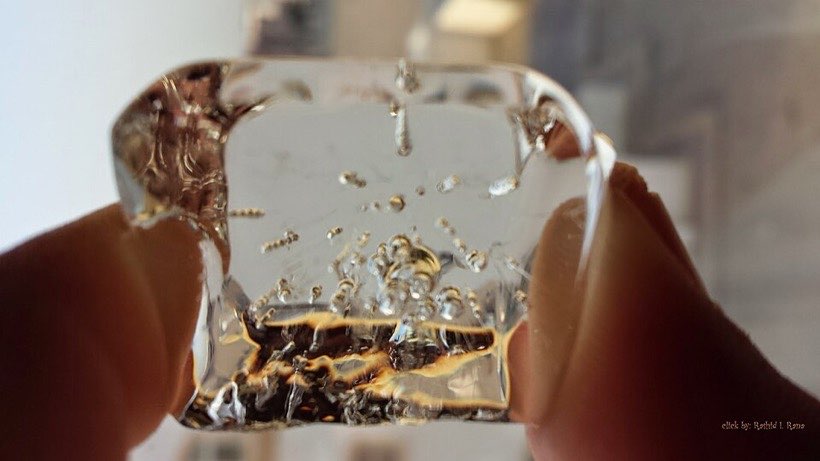
Solid to liquid
Melting is when a solid changes into a liquid. Heat gives the particles more energy, so they break out of their fixed rows. Ice, butter, chocolate and wax all melt when heated.
As a solid is heated, its particles vibrate more and more until they break free of their fixed places – the solid melts.
Melting point
Ice melts at 0 °C. This is its melting point. While ice is melting, the temperature stays at 0 °C until all the ice has gone. Water freezes at the same temperature. The freezing point of water is also 0 °C.
The heat taken in while ice melts does not raise the temperature; it is used to break the particles free.
Different solids
Every solid has its own melting point. Chocolate melts at about 34 °C, so it melts in your mouth. Iron melts at over 1,500 °C.
Candle wax, butter and chocolate are not pure substances, so they soften over a range of temperatures rather than melting at one exact point.
Melting and freezing in daily life
Kulfi and ice lollies are made by freezing flavoured milk or juice. Wax melts in a candle flame and freezes again as it drips.
Ice cream sellers in Bangladesh keep kulfi in boxes with ice and salt. Salty ice is colder than ordinary ice.
What I learnt
- I know that melting and freezing points are the same for a substance.
- I can explain a melting graph.