Grade 5 · Unit 1: Investigating plant growth
Plants and light
Plants make food from light – and grow towards it.
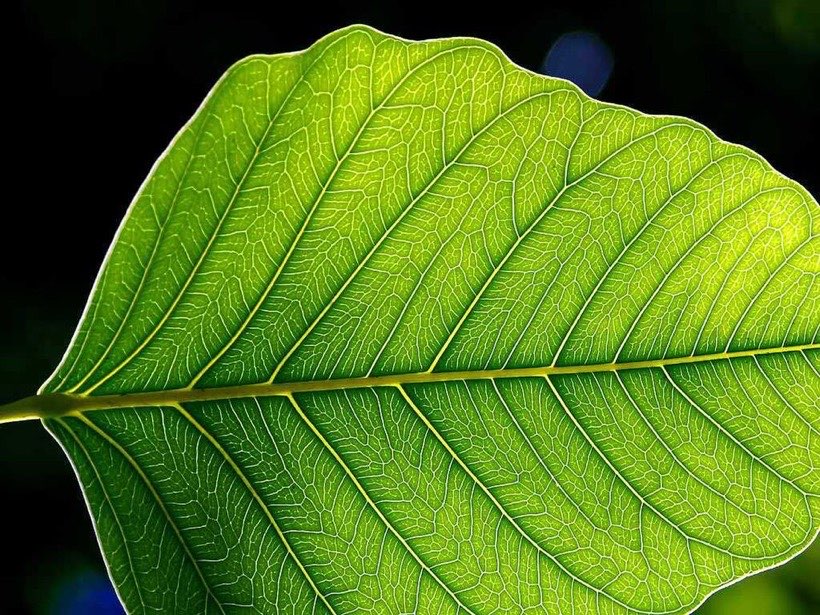
Making food from light
Green plants make their own food. This is called photosynthesis. Leaves use light, water and carbon dioxide to make sugar. They give out oxygen, the gas we breathe.
See how leaves make food from light in the Photosynthesis lab.
The sugar made in photosynthesis is used for energy and to build the plant. Some is stored as starch – in rice grains and potatoes, for example.
Why leaves are green
Leaves contain a green substance called chlorophyll. Chlorophyll traps the energy in light. Leaves are wide and flat to catch as much light as possible.
Leaves are green because of chlorophyll.
In autumn in colder countries, leaves stop making chlorophyll. The green fades, and yellow and red colours that were hidden show through.
Growing towards light
Plants grow towards light. This is called phototropism. A plant on a windowsill bends towards the window. Sunflowers turn their heads to follow the Sun.
A plant on a windowsill bends towards the window.
The side of the stem in the shade grows faster than the side in the light. This makes the stem bend towards the light.
Light and life
Plants are the start of almost every food chain. Without plants making food from sunlight, animals and people would have nothing to eat.
Almost all food chains start with plants using sunlight.
Even the fish we eat depend on plants: tiny floating plants in the water are eaten by small animals, which are eaten by fish.
Did you know? About half of the oxygen we breathe comes from tiny plant-like living things in the oceans.
Key words
- photosynthesis
- How green plants use light, water and carbon dioxide to make their own food.
- chlorophyll
- The green substance in leaves that traps light.
- oxygen
- A gas that plants give out and that we breathe in.
- phototropism
- When a plant grows towards light.
Activity: Shoebox maze
You need: a shoebox with a hole cut in one end, card to make walls inside, a bean seedling in a small pot
- Make a maze inside the box with card walls.
- Put the seedling at the opposite end from the hole. Close the lid.
- Open the box briefly every two days to water the plant and observe it.
- Draw how the shoot grows through the maze.
- Explain what you saw.
Think and talk
- Why could animals not survive without plants?
- Why are leaves usually wide and flat?
- How could you show that a plant grows towards light?
What I learnt
- I know that plants make food by photosynthesis using light.
- I know that plants grow towards light.