Light in the solar system
One star lights up all the planets and moons.
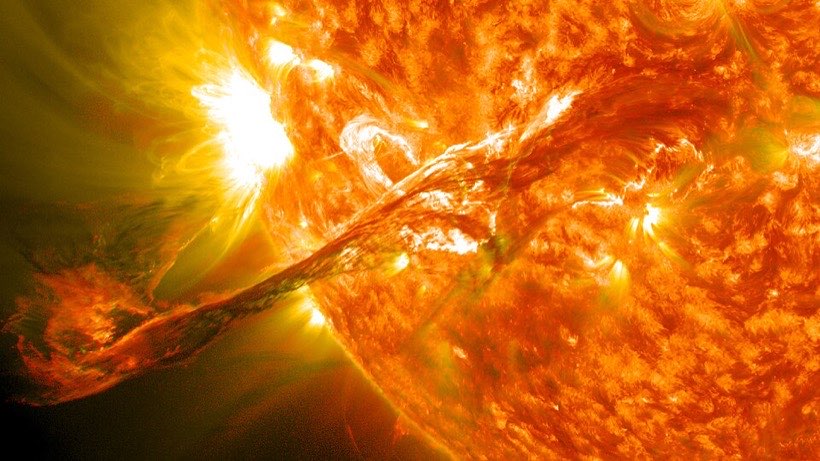
The Sun is a star
The Sun is a star. It gives out its own light. It is the only light source in the solar system. All the planets and moons are lit up by the Sun.
The Sun gives out enormous amounts of light and heat. Only a tiny part of its energy reaches the Earth, but it is enough for all life.
Planets reflect light
Planets do not make their own light. They reflect light from the Sun. Venus can be seen as a bright “evening star”, but it is really a planet. The Moon also shines by reflecting sunlight.
You can see Venus, Mars, Jupiter and Saturn without a telescope. They shine steadily, while stars seem to twinkle.
Orbits
The Earth travels round the Sun in an orbit. One orbit takes a year. The Moon orbits the Earth about once a month. Planets closer to the Sun, like Venus, take less time to orbit.
Mercury, the closest planet, orbits the Sun in just 88 days. Neptune, the furthest, takes about 165 years.
Eight planets
The eight planets in order from the Sun are Mercury, Venus, Earth, Mars, Jupiter, Saturn, Uranus and Neptune. There are also dwarf planets, asteroids and comets.
A sentence can help you remember the order of the planets, for example: “My Very Easy Method Just Speeds Up Naming.”
What I learnt
- I know that the Sun is the only light source in the solar system.
- I know that planets and moons reflect the Sun’s light.