How we see things
Light travels from a source, bounces off things and enters our eyes.
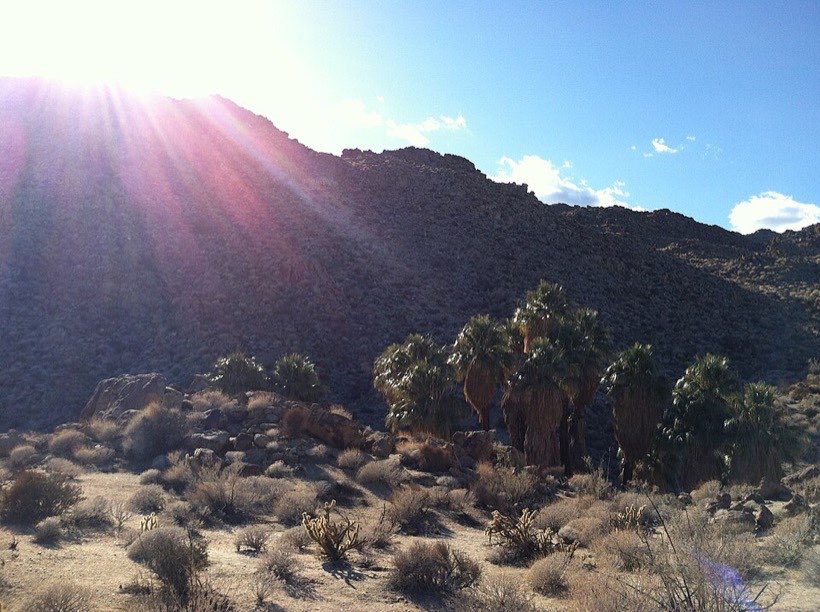
Seeing a palm tree
To see a palm tree, we need a light source, such as the Sun. Light travels from the Sun to the tree. Some light reflects off the tree into our eyes, and we see it.
On a cloudy day there is still enough light to see because sunlight passes through the clouds and is scattered all around.
In the dark cupboard
In a dark cupboard you cannot see a box, even if it is right in front of you. There is no light to reflect off the box. Switch on a torch and light reflects off the box into your eyes.
Some animals that live in total darkness, such as cave fish, have no working eyes at all – eyes would be useless without light.
Straight lines
Light travels in straight lines. Shine a torch down a straight tube and you can see the light at the other end. Bend the tube and the light is blocked. That is why you cannot see someone who has walked round a corner.
A torch beam in a dusty room or a sunbeam through a window shows clearly that light travels in straight lines.
Drawing rays
We draw light as rays: straight lines with arrows. One ray goes from the source to the object. Another goes from the object to the eye.
Ray diagrams are a model. Real light spreads out in all directions, but drawing one or two rays makes it easy to explain what happens.
What I learnt
- I know that we see when reflected light enters our eyes.
- I know that light travels in straight lines and can draw ray diagrams.