Grade 4 · Unit 5: Electricity and magnetism
Components and a simple circuit
Cells, bulbs, buzzers and motors – the parts of a circuit.
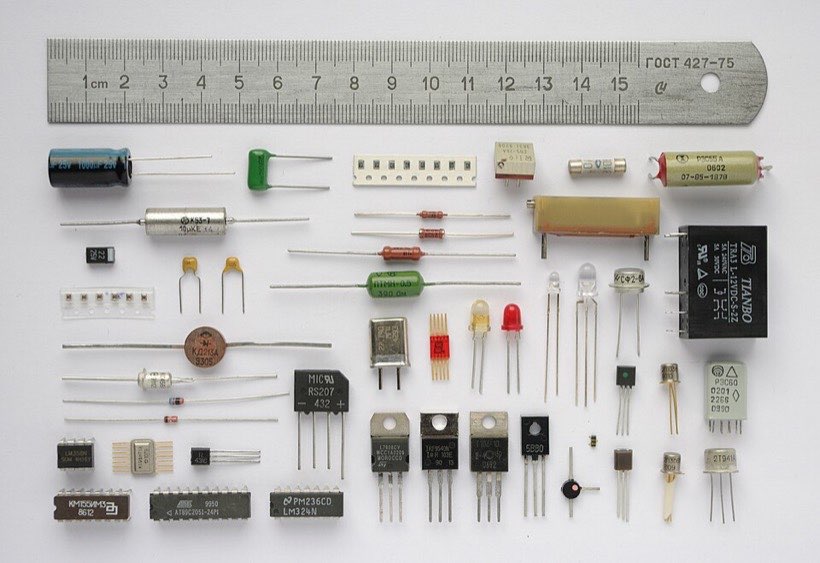
Circuit components
Each part of a circuit is a component. Common components are cells, wires, bulbs, buzzers, motors and switches. Each component does a different job.
Inside a phone or computer there are thousands of tiny components joined together on a circuit board.
What they do
A cell gives the push. Wires carry the current. A bulb changes electrical energy into light. A buzzer changes it into sound. A motor changes electrical energy into movement.
LEDs are another kind of light component. They use very little electricity and last for many years.
Drawing circuits
Drawing real-looking components takes a long time. Scientists use simple symbols instead: a circle with a cross for a bulb, long and short lines for a cell. Circuit diagrams use straight lines for wires.
Using the same symbols means that people all over the world can read each other’s circuit diagrams.
A simple circuit
The simplest circuit has a cell, a bulb and two wires. Each end of the bulb holder must be joined to a different end of the cell.
A torch is a simple circuit: cells, a switch, wires (or metal strips) and a bulb or LED, all in one loop.
What I learnt
- I can name common circuit components and say what they do.
- I can draw a simple circuit.