Grade 3 · Unit 5: Investigating materials
Magnetic materials
Which metals stick to a magnet?
Magnets pull
A magnet can attract some materials. It pulls them towards it. Materials that are attracted to a magnet are magnetic. Iron and steel are magnetic.
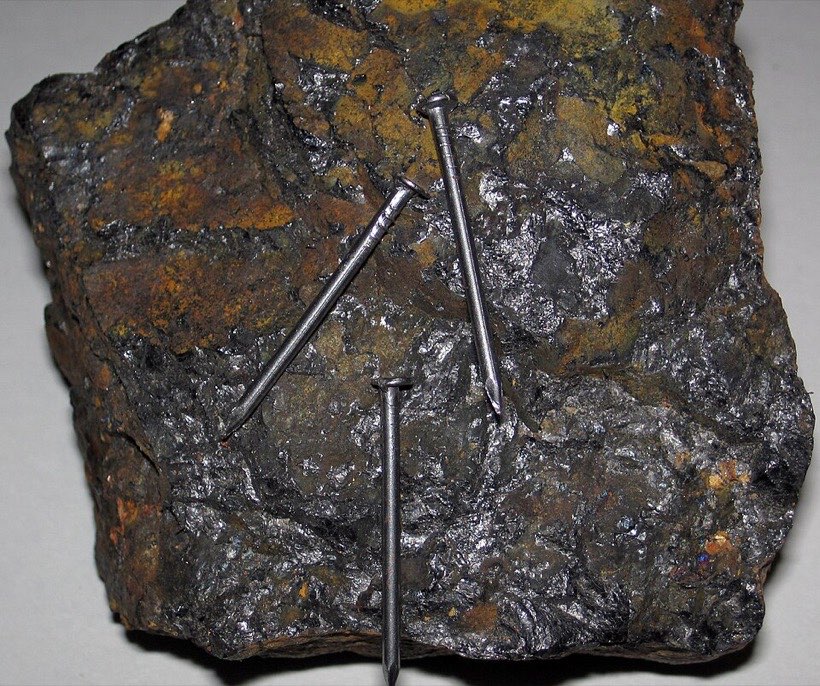
Steel nails stick to magnetite, a rock that is a natural magnet.
Not all metals!
Many people think all metals are magnetic – but they are not. Iron and steel are magnetic. Aluminium, copper, gold and silver are not. Wood, plastic, glass and paper are never magnetic.
Aluminium drink cans are not magnetic.
Recycling centres use huge magnets to pull steel cans out of rubbish. Aluminium cans are left behind, so the two metals are separated.
North and south poles
Every magnet has two poles: north (N) and south (S). Opposite poles attract: N and S pull together. The same poles repel: N and N push apart, and so do S and S.
A compass needle is a small magnet that points north.
A compass needle is a tiny magnet. The Earth acts like a giant magnet, so the needle always points north. Sailors and explorers use compasses to find their way.
Magnets everywhere
Magnets keep fridge doors and cupboard doors closed. They are inside speakers, headphones and electric motors. Magnets can even work through paper and thin plastic.
Small, strong magnets like these are used in fridge doors and cupboards.
Did you know? Some trains use powerful magnets to float above the track. They can go faster than 400 km/h!
Key words
- magnetic
- Attracted to a magnet.
- magnet
- An object that pulls iron and steel towards it.
- attract
- Pull towards.
- repel
- Push away.
- poles
- The two ends of a magnet, north (N) and south (S), where the pull is strongest.
Activity: Magnet test
You need: a magnet, objects: steel paper clip, aluminium foil, copper wire, iron nail, coin, plastic button, wooden pencil, steel spoon, drink can
- Predict which objects are magnetic.
- Touch the magnet to each object. Does it attract it?
- Sort the objects into “magnetic” and “not magnetic”.
- Were all the metals magnetic?
- Then test two magnets together. Which ends attract and which repel?
Think and talk
- Predict: is a coin magnetic? How could you find out?
- Why do recycling centres use magnets?
- What would happen if you put two north poles together?
What I learnt
- I know that magnets attract iron and steel.
- I know that not all metals are magnetic.
- I know that like poles repel and unlike poles attract.