Grade 3 · Unit 3: Living things
Growth and nutrition
All living things grow – but they need food to do it.
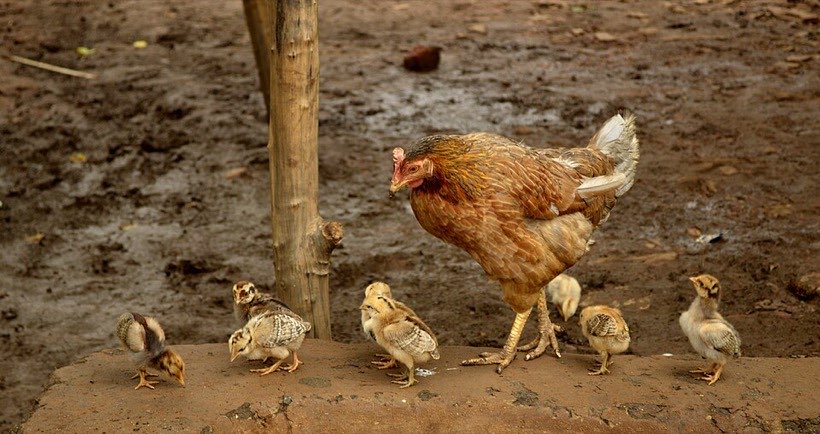
Everything grows
Growth is a life process. A baby grows into a child and then an adult. A seed grows into a plant, and a chick grows into a hen.
A chick grows into an adult hen.
These stages make a life cycle. When the adult has young, the cycle starts again.
Animals need food
Animals cannot make their own food. They must eat plants or other animals. Food gives them energy and nutrients to grow. Getting food is called nutrition.
Goats eat grass and leaves to get the nutrients they need.
Some animals eat only plants, like cows and goats. Some eat only other animals, like tigers. Some eat both, like humans and crows.
Plants make their food
Plants make their own food in their leaves. They use light, water and air. They also take in nutrients from the soil through their roots.
Leaves use sunlight to make food for the plant.
Farmers add manure or fertiliser to soil to give crops more nutrients, so they grow bigger.
Measuring growth
We can measure growth with a ruler or tape measure. Doctors measure babies’ height and mass to check they are healthy. You will keep growing until you are about 18 to 20 years old.
A height chart shows how much a child has grown.
Did you know? A blue whale calf can gain about 90 kilograms every day while it drinks its mother’s milk.
Key words
- growth
- Getting bigger or taller.
- nutrition
- Getting the food a living thing needs.
- nutrients
- The useful parts of food that help living things grow and stay healthy.
- adult
- A fully grown person, animal or plant.
- life cycle
- The stages a living thing goes through, from birth to adult and new young.
Activity: How tall are we?
You need: a tape measure fixed to the wall, a book to rest on heads, a class table or chart
- Work in pairs. Measure each other’s height in centimetres.
- Record everyone’s height in a class table.
- Who is tallest? Who is shortest? What is the difference?
- Make a bar chart of the heights in groups (for example 120–124 cm, 125–129 cm).
- Measure again at the end of the year. How much have you grown?
Think and talk
- How have you grown since you were a baby?
- Why do plants not need to eat?
- Which animals eat both plants and animals?
What I learnt
- I know that all living things grow.
- I know that animals eat food and plants make food.
- I can measure and record growth.