Grade 3 · Unit 1: Looking after plants
Plants and their parts
Every part of a plant has a job to do.
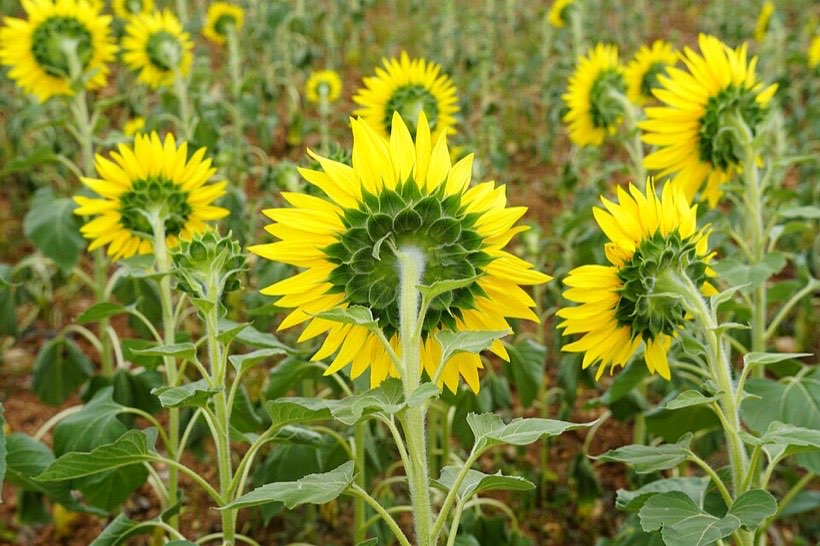
A plant is a living thing
Plants are living things, just like animals. Most plants have four main parts: roots, a stem, leaves and flowers. Each part has its own job. Together they keep the plant alive.
A sunflower plant: you can see its stem, leaves and big flower. Its roots are hidden in the soil.
Some plants are tiny, like moss on a wall. Others are huge, like the banyan trees in our villages. They still have the same kinds of parts.
Roots
Roots grow down into the soil. They hold the plant firmly so that wind and rain cannot pull it out. Roots take in water and minerals from the soil.
Where soil has washed away, you can see how roots spread out like a net.
We eat some roots! Carrots, radishes (mula) and sweet potatoes are roots that store food for the plant.
Did you know? The roots of one rice plant can spread out further than your arm is long.
Stems and leaves
The stem holds the leaves and flowers up towards the light. Inside the stem are tiny tubes that carry water from the roots to the leaves. Leaves use sunlight, air and water to make food for the plant.
Leaves are thin and flat so they can catch as much sunlight as possible.
A tree trunk is a very thick, strong stem. Bamboo stems are hollow, which makes them light but strong.
Flowers, fruits and seeds
Flowers make seeds. After the flower dies, a fruit often grows around the seeds to protect them. A seed can grow into a new plant.
A mango is a fruit. The big stone inside is the seed.
Mangoes, jackfruits and tomatoes are all fruits, because they have seeds inside. Some animals eat fruits and drop the seeds far away, so new plants can grow in new places.
Key words
- root
- The part under the ground that holds the plant and takes in water.
- stem
- The part that holds the plant up and carries water.
- leaf
- The flat green part that makes food for the plant.
- flower
- The part that makes seeds.
- fruit
- The part that grows around the seeds and protects them.
- seed
- A tiny package that can grow into a new plant.
- minerals
- Tiny amounts of useful things in soil that plants need to be healthy.
Activity: Plant detectives
You need: a small weed or plant dug up gently with its roots, a magnifying glass, paper and a pencil
- Wash the soil off the roots carefully.
- Find the roots, stem, leaves and flower (if it has one).
- Look at each part with the magnifying glass. What do you notice?
- Draw the plant and label its parts.
- Next to each label, write the job of that part.
Think and talk
- Which plant parts do we eat? Think of a root, a stem, a leaf, a flower, a fruit and a seed.
- What would happen to a plant with no roots?
- Why do you think leaves are flat and thin?
What I learnt
- I can name the parts of a flowering plant.
- I can describe the job of the roots, stem, leaves and flowers.