Grade 2 · Unit 3: Changing materials
Fantastic elastic
Stretchy things that spring back.
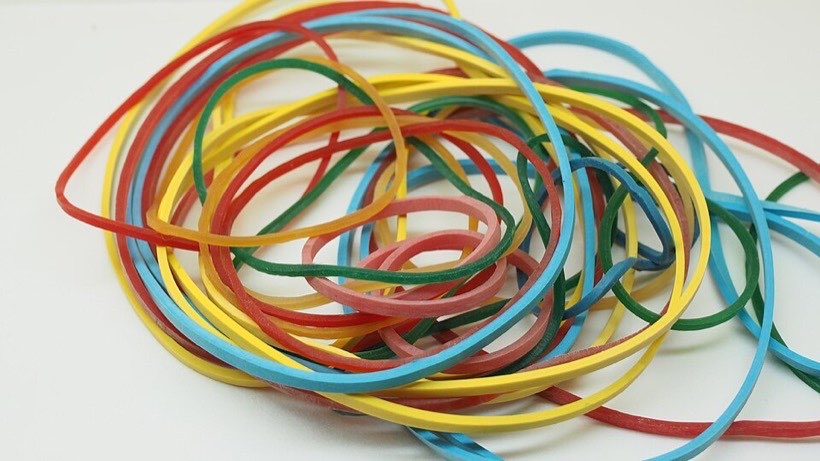
Spring back!
Stretch a rubber band, then let go. It goes back to its shape! Materials that do this are elastic.
Rubber bands stretch and then spring back.
Elastic materials store energy when you stretch them. That is how a catapult works.
Rubber
Rubber comes from the milky sap of rubber trees. It is very elastic. Tyres, balloons and balls are made of rubber.
Milky sap drips from a cut in a rubber tree.
The sap is called latex. It is collected every morning and made into rubber.
Springs
A spring is a coil of metal. Squash it or stretch it – it springs back. Springs are in pens, beds and weighing scales.
A metal spring. Squash it and it springs back.
Springs are found in pens, mattresses, cars and toys.
Bouncing balls
When a ball hits the ground, it squashes a little. It springs back into shape and bounces up!
A camera caught a bouncing ball many times. Each bounce is a little lower.
Each time the ball hits the ground, it squashes and springs back up.
Did you know? Rubber trees grow in Bangladesh, in places like Sylhet, Chattogram and Tangail.
Key words
- elastic
- Goes back to its shape after being stretched or squashed.
- rubber
- A stretchy material from the sap of rubber trees.
- spring
- A coil of metal that springs back.
- bounce
- Spring back up after hitting something.
Activity: How far does it stretch?
You need: a rubber band, a paper cup with a string handle, marbles or coins, a ruler, a hook or pencil to hang from
- Hang the cup from the rubber band. Measure how long the band is.
- Add 2 marbles. Measure again.
- Keep adding 2 marbles at a time and measuring.
- What pattern do you see? Take the marbles out – does the band go back?
Think and talk
- Which things in your home are elastic?
- Why are hair bands made of elastic?
- Is play dough elastic? How do you know?
What I learnt
- I know that elastic materials go back to their shape.
- I know that the more I pull an elastic band, the more it stretches.