Grade 2 · Unit 5: Caring for Our Planet
Product life cycles
Where do the things we use come from, and where do they go next?
From nature to your hand
Every object has a journey, called a life cycle. A cotton T-shirt starts as a plant in a field. The cotton is picked, spun into thread and woven into cloth. Workers cut and sew the cloth. Lorries and ships carry the T-shirt to a shop. At each step, materials, water and energy are used.
Cotton plants grow in a field.
The stages
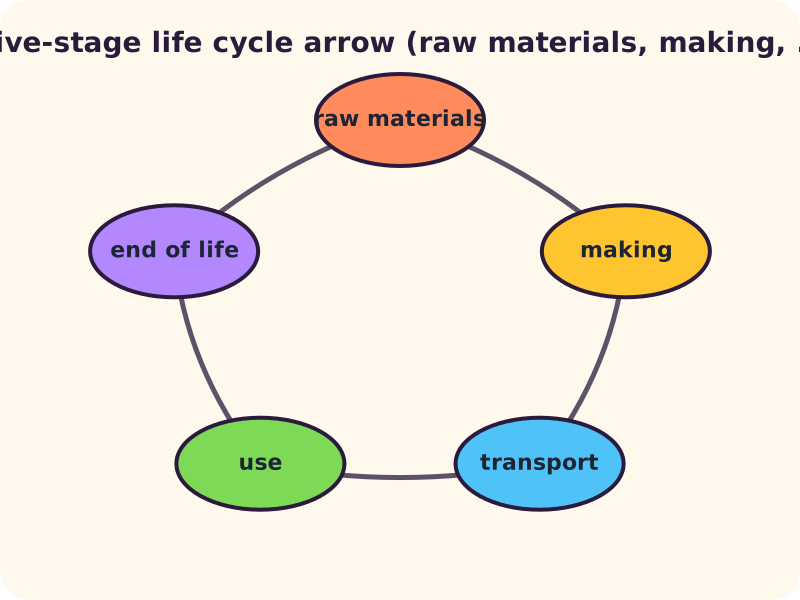
We can show a life cycle in five stages. First, raw materials are taken from nature. Next, the product is made. Then it is transported and sold. Then people use it. At the end it is thrown away, reused or recycled. This is the last stage. Each stage can affect people, animals and the environment.
A factory worker makes clothes.
A line or a circle?
Many products follow a straight line: take, make, throw away. This is called a linear economy. A circular economy is different. In a circle, things are used for as long as possible, then repaired, reused or recycled into new things. Less waste and fewer new raw materials are needed.
A repair café fixes broken things.
What can we choose?
We make choices every time we buy something. We can ask: do I need this? Can I borrow or buy it second-hand? Will it last? Can it be repaired? Choosing things that last longer and throwing away fewer things reduces the amount of waste. Companies can design products to be repaired and recycled too.
A second-hand market sells used goods.
Different viewpoints: A shop owner wants to sell more. A family on a small budget wants things to cost little. An environmental group asks people to buy less. How can everyone get what they need without making too much waste?
Did you know? The world makes billions of tonnes of waste every year, and the amount is growing.
Key words
- life cycle
- all the stages of a product from start to end
- raw material
- a natural material used to make something
- linear economy
- take, make, use, throw away
- circular economy
- keeping things in use by reusing, repairing and recycling
- consumer
- a person who buys and uses things
Activity: Your turn
- Choose an everyday object. Draw its life cycle. Then redesign it so that it makes less waste. Present your idea.
Think and talk
- What is one thing you own that you could repair or share instead of buying a new one?
What I learnt
- Every product has a life cycle.
- A circular economy wastes less than a straight line.
- Our choices as buyers matter.