Grade 2 · Unit 5: Caring for Our Planet
Food chains and food webs
What happens to a whole habitat when one living thing disappears?
Energy from the Sun
Nearly all life on Earth gets its energy from the Sun. Green plants catch sunlight and use it to make their own food. They are called producers. An animal cannot make its own food. It has to eat plants or other animals. Animals are called consumers. Energy passes from living thing to living thing as they eat and are eaten.
A leaf catches sunlight to make food for the plant.
A food chain
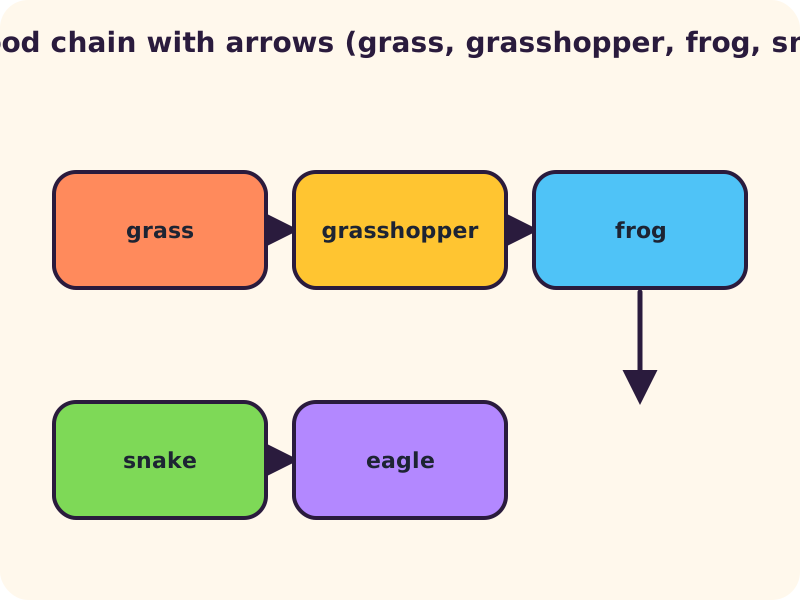
A food chain shows who eats what. Here is one: grass, then a grasshopper, then a frog, then a snake, then an eagle. The arrows point in the direction the energy goes. Animals that eat only plants are herbivores. Animals that eat only other animals are carnivores. Animals that eat both are omnivores.
A frog is a consumer in a pond food chain.
A food web
In real life, most animals eat more than one kind of food, and are eaten by more than one kind of animal. When we join many food chains together, we get a food web. A food web shows how living things in one habitat are linked. Pull one strand and the whole web feels it.
A lion hunts zebra on the African grassland.
Decomposers close the circle
What happens when plants and animals die? Decomposers such as fungi, bacteria and worms break them down. They turn them into nutrients that go back into the soil. Plants take up the nutrients and grow. So the energy and materials in an ecosystem go round and round. Nothing is wasted.
Mushrooms help to break down a fallen log.
Different viewpoints: A farmer may see a fox as a danger to chickens. An ecologist may see the same fox as an important hunter that keeps rabbits from eating all the crops. Both are looking at the same animal in different ways.
Did you know? The word "ecosystem" means all the living things in an area and the non-living things, like water, soil and air, that they depend on.
Key words
- producer
- a living thing that makes its own food, such as a plant
- consumer
- a living thing that eats other living things
- food chain
- a line showing who eats what
- food web
- many food chains joined together
- decomposer
- a living thing that breaks down dead plants and animals
- herbivore
- an animal that eats only plants
- carnivore
- an animal that eats only other animals
- omnivore
- an animal that eats both plants and animals
Activity: Your turn
- Choose a habitat near you. Draw a food web with at least eight living things. Then colour the producers green. What would happen if you took one animal away?
Think and talk
- In your web, which living thing would cause the biggest problem if it disappeared? Why?
What I learnt
- Plants make food from sunlight, so they are producers.
- Food chains join together into food webs.
- Decomposers return nutrients to the soil.