Grade 5 · Unit 8: Location and transformation
Coordinates in four quadrants
Negative coordinates too.
Story time: The game of Battleships
Tamim and his sister played Battleships on a grid from −5 to 5. “(−3, 2)!” called Tamim. “Miss!” “(4, −1)!” called his sister. “Hit!” Reading across first, then up or down, they could find any square – even in the negative quadrants.
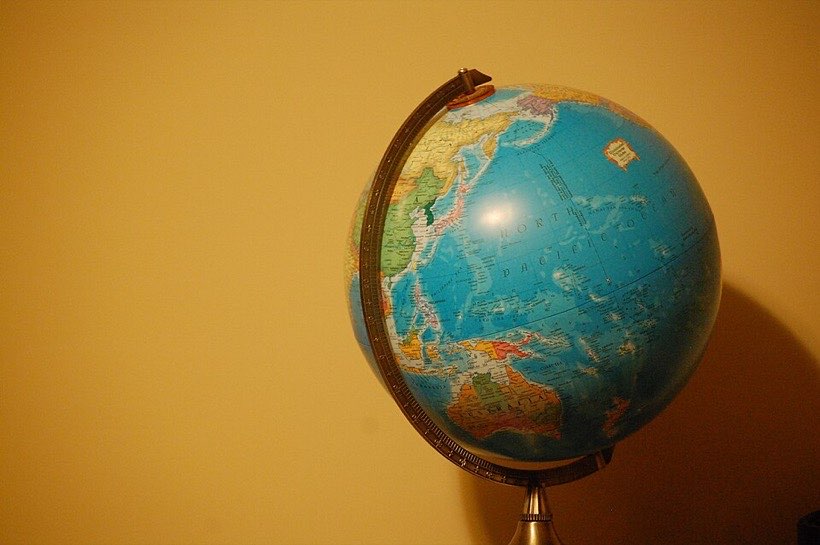
Latitude and longitude
Every place on Earth has coordinates. Dhaka is about 23.8° North, 90.4° East. Maths grids can also go below zero.
Globes use lines of latitude and longitude.
Four quadrants
The axes cross at the origin (0, 0). Left of the origin, x is negative. Below it, y is negative. This makes four quadrants.
A (2, 3), B (−3, 2), C (−2, −3), D (3, −2) – one point in each quadrant.
Plotting points
Always go across (x) first, then up or down (y). (−2, 5): 2 left, 5 up. (5, −3): 5 right, 3 down.
The signs tell you the quadrant.
Worked example
- Plot (−2, −3).
- Start at the origin. Move 2 left (x is negative).
- Then 3 down (y is negative). It is in the 3rd quadrant.
Shapes on a grid
Plot the three corners. A square has equal sides and right angles. The fourth corner is (−2, 1).
Use properties to find missing corners.
Your turn: Three corners of a rectangle are (−3, 1), (2, 1) and (2, −2). Find the fourth.
Did you know? René Descartes invented coordinates – the story says he watched a fly on his ceiling!
Key words
- quadrant
- One of the four parts of a coordinate grid.
- origin
- The point (0, 0).
- x-axis
- The horizontal axis.
- y-axis
- The vertical axis.
Meet the mathematician: Nicole Oresme
about 1320–1382 · Normandy, France
Nicole Oresme was a scholar and bishop in France. He drew diagrams that used a horizontal line and vertical lines to show how quantities change. These were early versions of graphs and coordinates. Three hundred years later, Descartes and Fermat developed coordinates fully.
Activity: Battleships
You need: four-quadrant grids from −5 to 5
- Secretly place 3 ships on your grid.
- Take turns to call coordinates.
- Mark hits and misses.
- First to sink all ships wins.
Think and talk
- Which quadrant has both coordinates negative?
- Where is (0, −4)?
- How do you find the fourth corner of a rectangle?
What I learnt
- I can read and plot coordinates in all four quadrants.
- I can find missing vertices.