Grade 5 · Unit 7: Geometric reasoning
Angle facts
Work out missing angles with reasons.
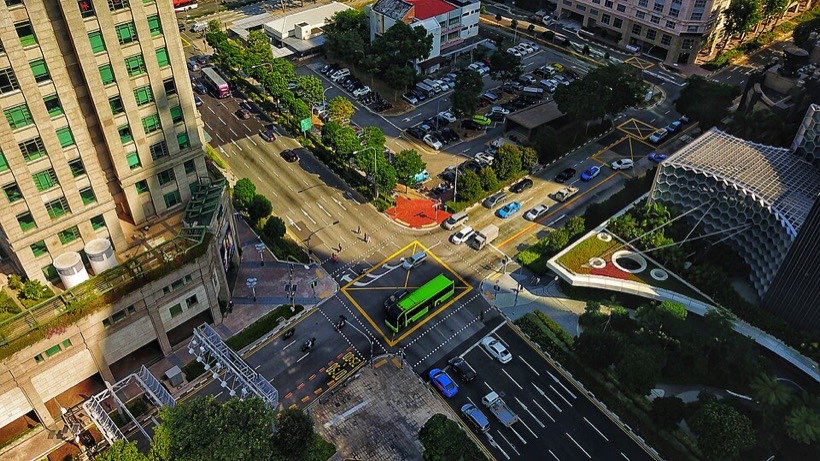
Story time: The crossing roads
From a rooftop, Mim photographed two roads crossing. She measured one angle: 65°. “Then the opposite angle is 65° too,” she said, “and the others are 115°.” Her friend checked: 65 + 115 + 65 + 115 = 360°. Correct!
Roads crossing
Where two roads cross, four angles are made. We can work out unknown angles using angle facts. Each answer needs a reason.
Roads cross at a junction.
Angles on a line and at a point
Angles on a line add to 180°. Angles at a point add to 360°. Missing angle = 180° − known angle.
Angles on a straight line add to 180°.
Your turn: Angles at a point: 100°, 140° and ?
Vertically opposite angles
Two crossing lines make 4 angles. Vertically opposite angles are equal. Neighbouring angles add to 180°.
Vertically opposite angles are equal.
Triangles and quadrilaterals
The angles of a triangle add to 180°. In a triangle with 50° and 60°, the third is 70°. The angles of a quadrilateral add to 360°.
Triangle: 180°. Quadrilateral: 360°.
Worked example
- An isosceles triangle has a top angle of 50°.
- The other two angles share 180 − 50 = 130°.
- Each base angle = 65°.
Did you know? Tear off the corners of a paper triangle and line them up – they make a straight line!
Drawing angles
Draw a straight line. Put the protractor’s centre on one end. Count from 0 to 65 and make a mark. Join it to the end of the line. An angle is a measure of turn: 65° is a little less than three quarters of a right angle.
Construct an angle with a ruler and protractor.
Key words
- angles on a line
- Add to 180°.
- angles at a point
- Add to 360°.
- vertically opposite
- Angles opposite each other where two lines cross; they are equal.
- angle sum
- The total of the angles in a shape.
Meet the mathematician: Nasir al-Din al-Tusi
1201–1274 · Tus (now Iran)
Al-Tusi built a great observatory at Maragheh with a large library. He wrote the first book to treat trigonometry – the maths of angles and triangles – as a subject of its own. He made very accurate tables of the movements of the planets. Scientists came from far away to work with him.
Activity: Torn triangles
You need: paper triangles, scissors
- Draw and cut out any triangle.
- Tear off the three corners.
- Place them together at a point on a straight line.
- What do they make? Explain why.
Think and talk
- Why do angles in a triangle add to 180°?
- Can a triangle have two obtuse angles?
- What reason would you give for a missing angle?
What I learnt
- I can find missing angles on a line and at a point.
- I know vertically opposite angles are equal.
- I can use angle sums of triangles and quadrilaterals.