3D shapes and surface area
How much card makes a box?
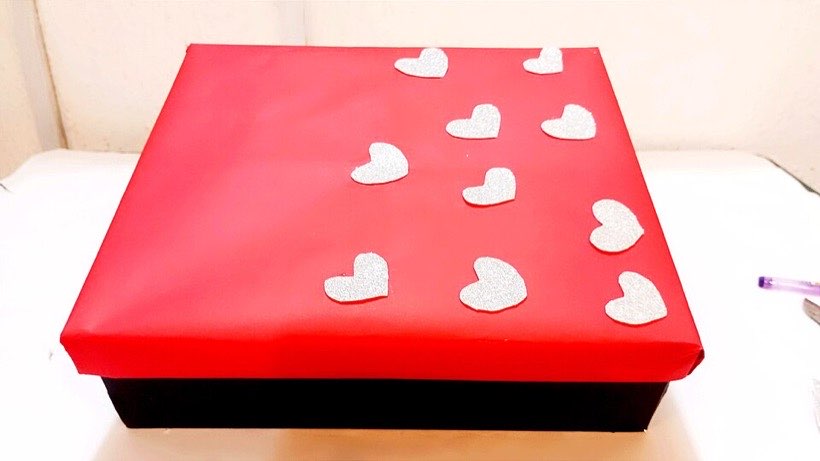
Story time: The sweet box
A mishti shop in Bogura needed new boxes for its famous yoghurt sweets. The designer drew a net and worked out the card needed. Box: 20 cm × 15 cm × 8 cm. Surface area = 2 × (300 + 160 + 120) = 1160 cm². “Less card means less cost – and less waste,” said the shop owner.
Making boxes
A box is made from a flat net of card. The area of card is the surface area. Designers try to use as little card as possible.
Gift boxes are made from flat card.
Nets
Count the faces in the net. A cube has 6 square faces. If each is 3 cm × 3 cm, the surface area is 6 × 9 = 54 cm².
A net of a cube: 6 equal squares.
Surface area of a cuboid
Top and bottom: 2 × (4 × 3) = 24. Front and back: 2 × (4 × 2) = 16. Sides: 2 × (3 × 2) = 12. Surface area = 24 + 16 + 12 = 52 square units.
Three pairs of matching faces.
Worked example
- Surface area of a 5 × 3 × 2 cuboid.
- Pairs of faces: 2 × 15, 2 × 10, 2 × 6.
- 30 + 20 + 12 = 62 square units.
Cross-sections
Slice a cylinder: circle. Slice a triangular prism: triangle. Prisms have a constant cross-section.
A prism has the same cross-section all along.
Your turn: What is the cross-section of a triangular prism?
Did you know? Tetra Pak cartons were designed to use as little material as possible.
Regular polyhedra
A regular polyhedron has identical regular faces and the same number meeting at every vertex. There are only 5: tetrahedron, cube, octahedron, dodecahedron and icosahedron. A triangular prism is irregular – its faces are triangles and rectangles.
A cube is a regular polyhedron; a prism is not.
Key words
- surface area
- The total area of all the faces of a 3D shape.
- net
- A 2D shape that folds into a 3D shape.
- cross-section
- The shape you see when you slice through a solid.
Meet the mathematician: Theaetetus
about 417–369 BCE · Athens, Greece
Theaetetus was a student of Plato in ancient Athens. He is believed to have proved that there are exactly five regular polyhedra. They are the tetrahedron, cube, octahedron, dodecahedron and icosahedron. Today they are called the Platonic solids.
Activity: Box design
You need: squared card, scissors, tape
- Design a box to hold 24 one-centimetre cubes.
- Draw two different nets.
- Find the surface area of each.
- Which design uses less card?
Think and talk
- How is surface area different from volume?
- Which uses less card: a long thin box or a cube with the same volume?
- What is the cross-section of a pencil?
What I learnt
- I can find surface area from a net.
- I can find the surface area of a cuboid.
- I can describe cross-sections.