Probability
Fractions, decimals and percentages of chance.
Story time: The weather app
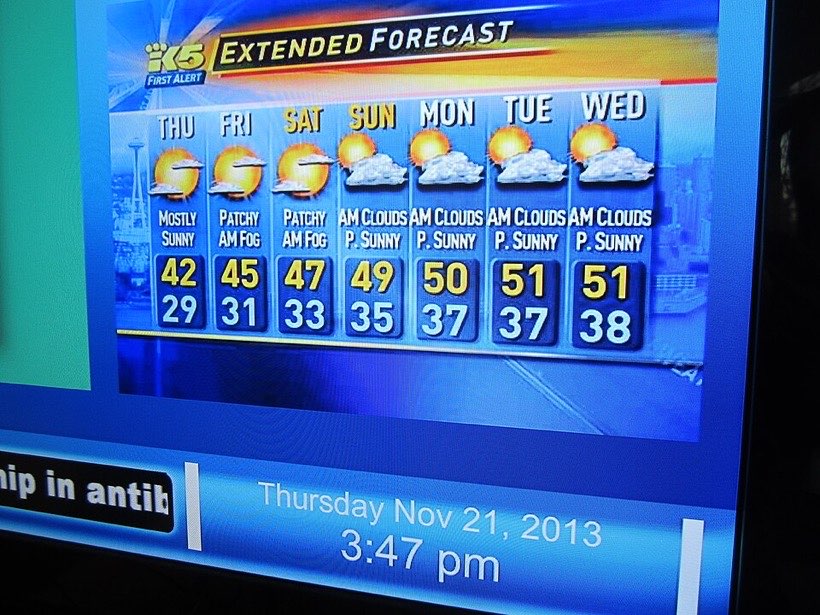
Nadia’s weather app said: “70% chance of rain today.” “Should I take an umbrella?” she asked. Her brother said: “70% is 0.7 – quite likely. And 30% chance it stays dry.” She took the umbrella. It rained at lunchtime!
Weather forecasts
A forecast says “70% chance of rain”. That is a probability of 0.7. The chance of no rain is 30%, or 0.3.
Forecasts give the chance of rain as a percentage.
Fractions, decimals, percentages
There are 8 equal sections. P(red) = 3/8 = 0.375 = 37.5%. P(not red) = 1 − 3/8 = 5/8.
P(red) = 3/8 = 0.375 = 37.5%
Sample spaces
List all outcomes in a sample space. Two coins: HH, HT, TH, TT. P(one head and one tail) = 2/4 = ½.
Two coins: 4 equally likely outcomes.
Worked example
- Toss two coins. List the outcomes: HH, HT, TH, TT.
- Exactly one head: HT and TH – 2 outcomes.
- P(exactly one head) = 2/4 = ½.
Two dice
There are 6 × 6 = 36 outcomes. A total of 7 appears 6 times: P(7) = 6/36 = ⅙. A total of 2 appears once: P(2) = 1/36.
36 outcomes when two dice are added.
Your turn: Two dice. P(total of 7)?
Did you know? In Ludo, 7 is the most likely total of two dice.
Can both happen?
Some events cannot happen at the same time: one spin cannot be red and blue. Other events can: a dice can show an even number and a number greater than 3 (4 or 6). Probability can be written from 0 to 1 or from 0% to 100%.
One spin cannot land on red and blue at once.
Key words
- probability
- A number from 0 to 1 that shows how likely an event is.
- sample space
- A list of all possible outcomes.
- complementary
- P(not A) = 1 − P(A).
- combined events
- Two things happening together, like two coins.
Meet the mathematician: Pierre-Simon Laplace
1749–1827 · Normandy, France
Laplace was one of the greatest scientists of France. He wrote that probability is the number of favourable outcomes divided by the number of all equally likely outcomes. He used probability to study the stars, populations and even court cases. He said probability is “common sense reduced to calculation”.
Activity: Sample space table
You need: paper
- Draw a table for a coin and a 1–6 dice.
- List all 12 outcomes.
- Find P(heads and an even number).
- Make up two more probability questions.
Think and talk
- Why is 7 the most likely total with two dice?
- If P(win) = 0.15, what is P(not win)?
- List the sample space for a coin and a dice.
What I learnt
- I can express probability as a fraction, decimal or percentage.
- I can list sample spaces.
- I can use P(not A) = 1 − P(A).