Grade 5 · Unit 1: Number and place value
Long multiplication
3-digit × 2-digit numbers on paper.
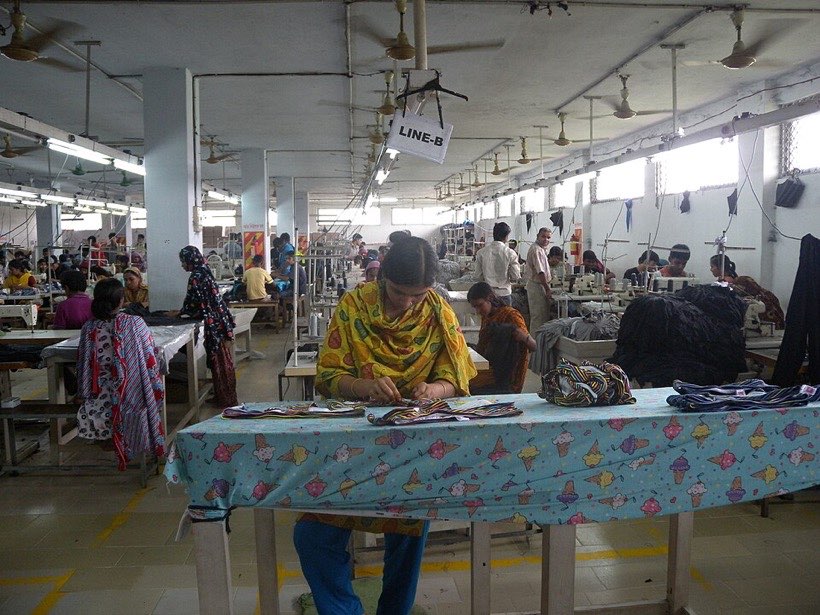
Story time: The shirt factory
A factory line makes 245 shirts an hour and works 18 hours a day. “How many shirts a day?” asked the new supervisor, Lima. She estimated 250 × 20 = 5000, then used long multiplication. 4410 shirts a day – a bit less than her estimate, because she rounded both numbers up.
Garment factory
A factory line makes 245 shirts an hour for 18 hours. How many shirts? Estimate: 250 × 20 = 5000.
Garment factories make thousands of shirts each day.
Grid method
Split both numbers. Row for 10: 2000 + 400 + 50 = 2450. Row for 8: 1600 + 320 + 40 = 1960. Total 4410.
245 × 18 = 2450 + 1960 = 4410.
Worked example
- Grid method for 136 × 24.
- Row 20: 2000 + 600 + 120 = 2720. Row 4: 400 + 120 + 24 = 544.
- 2720 + 544 = 3264.
Long multiplication
Multiply 245 by 8: 1960. Multiply 245 by 10: 2450 (write the 0 first). Add the partial products: 4410.
Multiply by the ones, then by the tens, then add.
Check
We rounded 245 up to 250 and 18 up to 20. So the real answer should be smaller than 5000. 4410 makes sense.
Both numbers were rounded up, so the estimate is bigger.
Your turn: Estimate 412 × 19.
Did you know? Bangladesh’s garment factories employ around 40 lakh workers.
4-digit × 3-digit
Multiply by each part of 123: 100, 20 and 3. Add the three partial products. Estimate: 2000 × 100 = 200 000 and 2500 × 120 = 300 000, so 288 435 is sensible.
Split the 3-digit number into hundreds, tens and ones.
Worked example
- Use compatible numbers to estimate 4120 × 198.
- 4000 × 200 = 800 000.
- The real answer (815 760) is close.
Key words
- long multiplication
- A column method for multiplying by a 2-digit number.
- partial product
- The result of multiplying by one digit.
Meet the mathematician: Luca Pacioli
1447–1517 · Tuscany, Italy
Luca Pacioli wrote a huge maths book in 1494 called the Summa. It showed eight different ways to multiply large numbers, including the lattice method. Merchants used his book to calculate prices and profits. He also explained how to keep accounts of money in and out.
Activity: Factory planner
You need: paper
- A factory makes 136 bags an hour.
- How many in an 8-hour, 12-hour and 24-hour day?
- Use long multiplication.
- Check with estimates.
Think and talk
- Why do we write a zero before multiplying by the tens digit?
- How does the grid method match long multiplication?
- Why was our estimate too big?
What I learnt
- I can multiply 3-digit by 2-digit numbers.
- I can estimate to check.