Grade 5 · Unit 1: Number and place value
Long division
Dividing by 2-digit numbers.
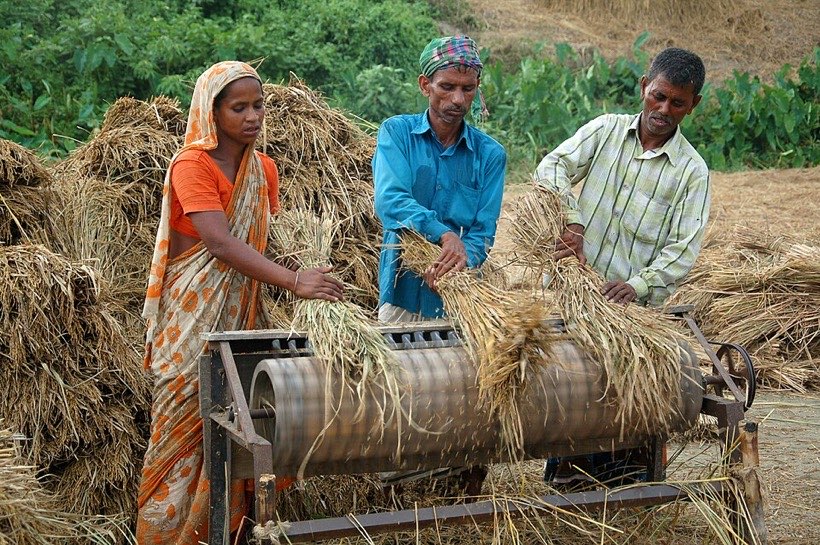
Story time: Sharing the harvest
A farming cooperative in Bogura harvested 4872 kg of rice. It was shared equally among 24 families. They used long division: 4872 ÷ 24 = 203 kg each. “Nothing left over,” said the leader. “A fair share for everyone.”
Sharing a harvest
A cooperative harvests 4872 kg of rice to share among 24 families. How much does each family get? Estimate: 4800 ÷ 24 = 200.
Rice harvest being shared out.
Chunking
200 × 24 = 4800, leaving 72. 3 × 24 = 72, leaving 0. Each family gets 203 kg.
Take away big multiples of 24.
Your turn: 672 ÷ 16 = ?
Long division
48 ÷ 24 = 2. 7 ÷ 24 = 0, write 0. Bring down 2: 72 ÷ 24 = 3. Answer: 203.
Divide, multiply, subtract, bring down.
Remainders as fractions and decimals
A remainder can be a whole number, a fraction or a decimal. 250 ÷ 12 = 20⅚. Choose the form that fits the problem.
Remainders can be written in different ways.
Worked example
- A bus holds 45. How many buses for 200 learners?
- 200 ÷ 45 = 4 remainder 20.
- Round up: 5 buses, so no one is left behind.
Did you know? If you share ৳250 among 12, each gets ৳20.83 and 4 poisha are left over.
Words for each part
Explaining your method clearly uses these words. In 360 ÷ 15 = 24, 360 is the dividend, 15 the divisor and 24 the quotient. Choose a method: mental, written or calculator – and say why.
Use the right words to explain your working.
Key words
- long division
- A written method for dividing by a 2-digit number.
- quotient
- The answer to a division.
Meet the mathematician: Mary Somerville
1780–1872 · Jedburgh, Scotland
Mary Somerville taught herself maths from books, often secretly at night. She explained difficult ideas about the planets in clear English that many people could read. She was one of the first two women members of the Royal Astronomical Society, in 1835. Somerville College at Oxford is named after her.
Activity: Class trip costs
You need: trip cost cards
- A trip costs ৳8,640 for 32 learners.
- Find the cost per learner using long division.
- Check by multiplying.
- Try other trip costs.
Think and talk
- When is a decimal remainder better than a fraction?
- Why is estimating first so useful?
- Explain “divide, multiply, subtract, bring down”.
What I learnt
- I can divide by 2-digit numbers.
- I can write remainders as fractions or decimals.