Grade 4 · Unit 8: Location and transformation
Translations and tessellations
Slide, flip and fit shapes together.
Story time: The new mosque floor
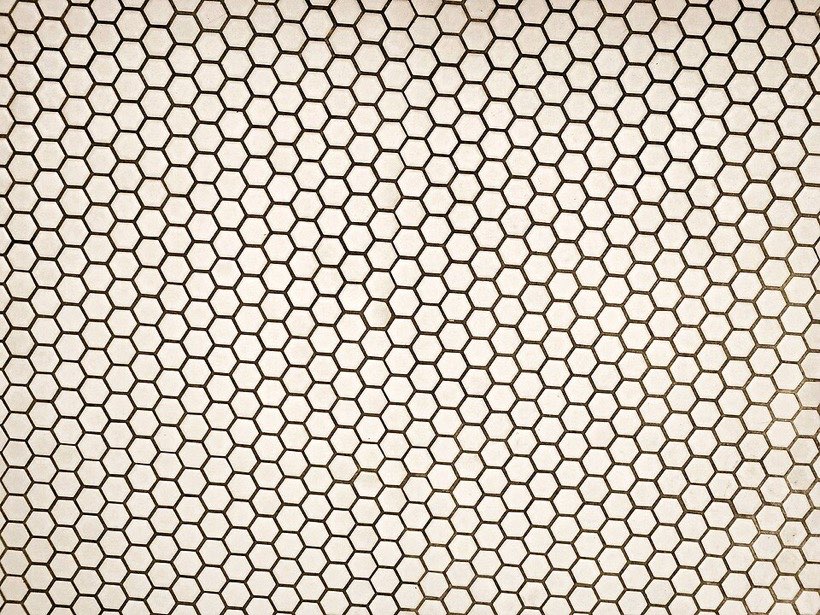
Builders were tiling the floor of a new mosque in Sylhet. They used hexagon tiles that fitted together perfectly. At the edge, they reflected a pattern so both sides matched. “Every tile is the same shape, slid into place,” explained the builder to the curious children.
Tiled floors
Look at tiled floors: the same shape repeats again and again. Each tile is slid, flipped or turned into place. A pattern with no gaps or overlaps is a tessellation.
Hexagon tiles fit together with no gaps.
Translation
In a translation, every point moves the same way. The corner (1, 1) moves to (5, 3); (3, 1) moves to (7, 3). These are corresponding points: 4 right, 2 up.
Every square moved 4 right and 2 up.
Reflection
A reflection flips a shape over a mirror line. Each vertex is the same distance from the line on the other side. When the shape is slanted, reflect each vertex carefully, one by one.
Each point is the same distance from the mirror line.
Worked example
- A vertex is 2 squares left of the mirror line.
- Its image is 2 squares right of the line, on the same row.
- Repeat for every vertex, then join them.
Which shapes tessellate?
Regular triangles, squares and hexagons tessellate on their own. Regular pentagons leave gaps. Octagons need small squares in between – look at many bathroom floors!
Triangles, squares and hexagons tessellate on their own; regular pentagons and octagons do not.
Your turn: Why do squares tessellate? (Hint: 4 corners meet at a point.)
Key words
- translation
- A slide: every point moves the same distance and direction.
- tessellation
- A pattern of shapes that fit with no gaps or overlaps.
Meet the mathematician: Maryam Mirzakhani
1977–2017 · Tehran, Iran
Maryam Mirzakhani loved to doodle shapes and curved surfaces. She studied how paths move across surfaces like doughnuts and twisted shapes. In 2014 she became the first woman to win the Fields Medal, the top prize in mathematics. She said she liked maths because it was like solving a mystery.
Activity: Make an Escher-style tile
You need: a card square, scissors, tape, paper
- Cut a shape out of one side of the square.
- Slide it to the opposite side and tape it.
- Draw round your new tile again and again to tessellate.
- Decorate it as an animal or a flower.
Think and talk
- Where do you see tessellations in Bangladesh?
- What changes and what stays the same in a translation?
- Can any triangle tessellate?
What I learnt
- I can translate shapes and find corresponding points.
- I can reflect shapes in mirror lines.
- I can tessellate shapes.