3D shapes and nets
Visualise shapes from different views.
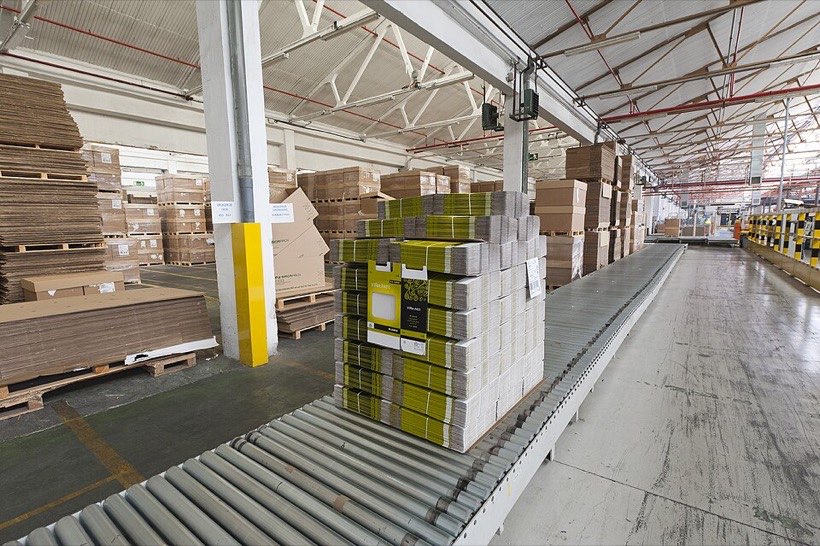
Story time: The tea box
Sylhet is famous for its tea. A tea company needed a new box design. The designer drew a net on card: 6 rectangles in 3 matching pairs. She folded it up – a perfect cuboid. Then she drew the plan and front view so the factory could make thousands.
Packaging
Boxes, tubes and cartons are 3D shapes. Designers draw nets to make them. They also draw views from different sides.
Packaging comes in many 3D shapes.
Polyhedra
A polyhedron has only flat faces. Cubes, prisms and pyramids are polyhedra. Cylinders, cones and spheres have curved surfaces.
Polyhedra have flat faces; cylinders and cones do not.
Euler’s rule
- Square pyramid: 5 faces, 5 vertices, 8 edges.
- 5 + 5 − 8 = 2.
- It works – try it on any polyhedron!
Nets of a cuboid
A cuboid net has 6 rectangles in 3 matching pairs. Opposite faces must not touch in the net. Imagine folding before you cut.
A net of a 2 × 1 × 1 cuboid: four long faces in a strip and two square ends.
Plans and elevations
The plan is the view from above. The elevation is the view from the front or side. Architects use plans and elevations to design buildings.
Different views of the same shape.
Your turn: What is the front view of a cone?
Did you know? Only 5 polyhedra have all faces the same regular shape – the Platonic solids.
11 nets of a cube
There are exactly 11 different nets that fold into a cube. Here are two of them. Can you find more on squared paper? Sketch 3D shapes from different directions: a cylinder looks like a rectangle from the side.
Two of the 11 different cube nets.
Key words
- net
- A 2D pattern that folds into a 3D shape.
- plan
- The view from above.
- elevation
- The view from the front or side.
- polyhedron
- A 3D shape with flat faces.
Meet the mathematician: Leonhard Euler
1707–1783 · Basel, Switzerland
Euler was one of the most productive mathematicians ever – he wrote about 800 papers. He found a rule for solid shapes with flat faces: faces + vertices − edges = 2. For a cube: 6 + 8 − 12 = 2. He kept working even after he became blind, doing huge calculations in his head.
Activity: Build from views
You need: interlocking cubes, squared paper
- Build a small model with 6 cubes.
- Draw its plan, front and side views.
- Give your drawings to a partner.
- Can they build your model?
Think and talk
- How can a cone and a pyramid both look like a triangle from the front?
- Which 3D shape has a circle plan and a rectangle front view?
- Why do architects need plans?
What I learnt
- I can identify polyhedra.
- I can draw and use nets.
- I can draw plans and elevations.