Grade 4 · Unit 4: Patterns and algebra
Number patterns and rules
Write rules with words and letters.
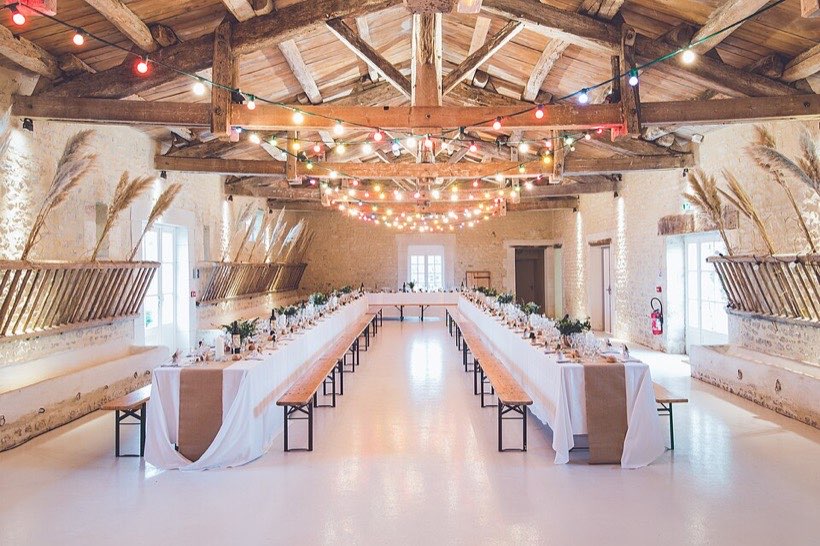
Story time: The wedding tables
For her sister’s wedding, Nipa helped push tables together in a long line. One table seats 6. Two tables seat 10. Three seat 14. “How many tables for 82 guests?” asked her uncle. Nipa found the rule: seats = 4 × tables + 2. 4 × 20 + 2 = 82. “20 tables!”
Tables and chairs
1 table seats 6. 2 tables pushed together seat 10. 3 tables seat 14. Can we predict how many seats for 20 tables?
Tables pushed together for a wedding feast.
Term-to-term
The term-to-term rule is “add 4”. This helps find the next term. But 20 tables would take a long time!
Each new table adds 4 seats.
Position-to-term
Each table gives 4 seats, plus 2 at the ends. Seats = 4 × tables + 2. For 20 tables: 4 × 20 + 2 = 82 seats.
Seats = tables × 4 + 2.
Worked example
- Rule: 3n + 1. Find the 12th term.
- n = 12: 3 × 12 = 36.
- 36 + 1 = 37.
Using letters
Let t be the number of tables and s the seats. s = 4t + 2 is an expression with a variable. Now we can find s for any t.
A letter can stand for any number.
Your turn: Sequence 7, 11, 15, 19 … Write the rule with n.
Did you know? Using letters for numbers is called algebra – from the Arabic word al-jabr.
Patterns with fractions and place value
Patterns can use fractions and decimals: 0.2, 0.4, 0.6 … Place-value patterns: 3 × 2 = 6, 3 × 20 = 60, 3 × 200 = 600. Use a calculator to explore: start at 5 and keep adding 25. What do you notice?
½, 1, 1½, 2 … add a half each time.
Key words
- term-to-term rule
- How to get from one term to the next.
- position-to-term rule
- How to get a term from its position number.
- variable
- A letter that stands for a number that can change.
- expression
- Numbers, letters and signs together, like 3n + 1.
Meet the mathematician: Ada Lovelace
1815–1852 · London, England
Ada Lovelace loved maths from a young age. She worked with Charles Babbage on his design for a calculating machine. In 1843 she wrote steps for the machine to produce a pattern of numbers – the first computer program. She imagined that machines could one day make music and pictures too.
Activity: Matchstick sequences
You need: matchsticks or straws
- Make a row of triangles: 1 triangle = 3 sticks, 2 triangles = 5 sticks …
- Record in a table up to 5 triangles.
- Find the term-to-term rule.
- Find a rule for any number of triangles: sticks = 2n + 1.
Think and talk
- Why is the position-to-term rule more useful than term-to-term?
- Where does the “+ 2” come from?
- How many tables seat 50 people?
What I learnt
- I can describe term-to-term and position-to-term rules.
- I can use letters to write rules.