Grade 4 · Unit 2: Fractions and decimals
Calculating with decimals
Add, subtract, multiply, divide and round decimals.
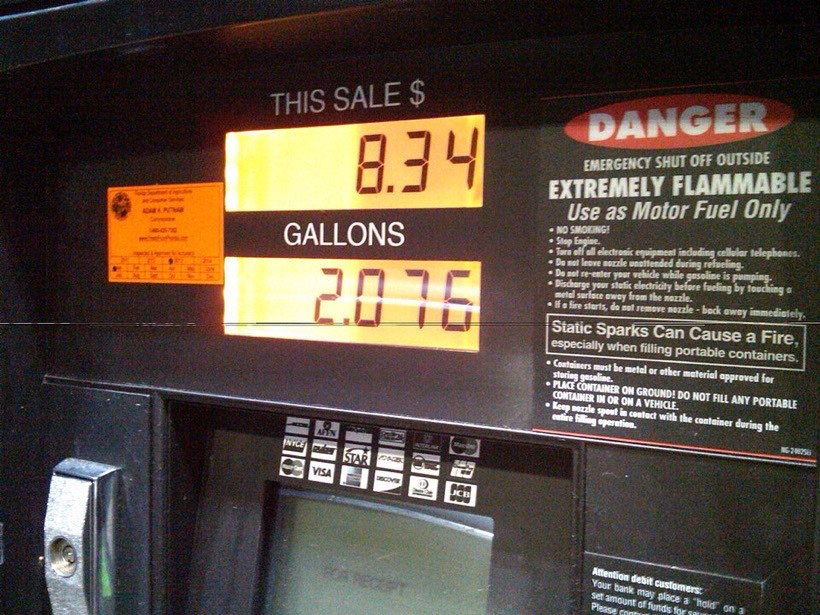
Story time: The fuel stop
A CNG auto-rickshaw driver fills his tank at the station. The meter shows 6.5 units at ৳43 per unit. “That is 6.5 × 43,” says his son, “about 7 × 40 = 280.” The bill says ৳279.50 – very close to his estimate!
Decimals every day
Fuel pumps, scales and shop bills use decimals. We need to add, subtract, multiply and divide them. Always estimate first.
Fuel pumps show decimals for the amount and the price.
Adding and subtracting
Line up the decimal points, then add as normal. Fill empty places with zeros: 8.6 = 8.60. 15.2 − 7.85 = 7.35 (write 15.20 first).
Line up the decimal points.
Multiplying decimals
0.4 × 3: 4 × 3 = 12. One decimal place → 1.2. 1.5 × 0.2: 15 × 2 = 30. Two decimal places → 0.30 = 0.3. Check with an estimate: 1.5 × 0.2 is a bit less than 2 × 0.2 = 0.4.
Multiply as whole numbers, then count the decimal places.
Worked example
- 3.6 × 4: estimate 4 × 4 = 16.
- 36 × 4 = 144; one decimal place → 14.4.
- 14.4 is close to 16 ✓.
Dividing decimals
4.8 ÷ 4 = 1.2: share 48 tenths into 4 groups of 12 tenths. × 10 moves digits one place left; ÷ 100 moves them two places right: 37.5 ÷ 100 = 0.375. 6 ÷ 0.5 = 12: how many halves in 6?
Four equal jumps of 1.2 make 4.8.
Rounding decimals
To round to a whole number, look at the tenths: 3.46 → 3. To one decimal place, look at the hundredths: 3.46 → 3.5. A shirt at ৳749.50 is about ৳750.
3.46 rounds to 3 (whole) and 3.5 (one decimal place).
Your turn: Round 12.68 to the nearest whole number.
Key words
- decimal place
- A position after the decimal point: tenths, hundredths …
Meet the mathematician: Jamshid al-Kashi
about 1380–1429 · Kashan, Iran
Al-Kashi worked at a great observatory in Samarkand. He was a master of calculating with decimal fractions. In 1424 he worked out the value of π to 16 decimal places – a record for about 180 years. He wrote a famous book called “The Key to Arithmetic”.
Activity: Shop maths
You need: price list with decimals, calculator to check
- Choose 3 items and estimate the total.
- Add exactly with column addition.
- Find the cost of 4 of one item.
- Share ৳99.60 equally between 4 people.
Think and talk
- Why must the decimal points line up?
- Why is 0.4 × 3 bigger than 0.4 but 0.4 × 0.5 smaller than 0.4?
- Where do you round prices in real life?
What I learnt
- I can add and subtract decimals.
- I can multiply and divide decimals by whole numbers.
- I can round decimals.