Grade 4 · Unit 1: Number and place value
Written division
Divide 3-digit numbers by 1-digit numbers.
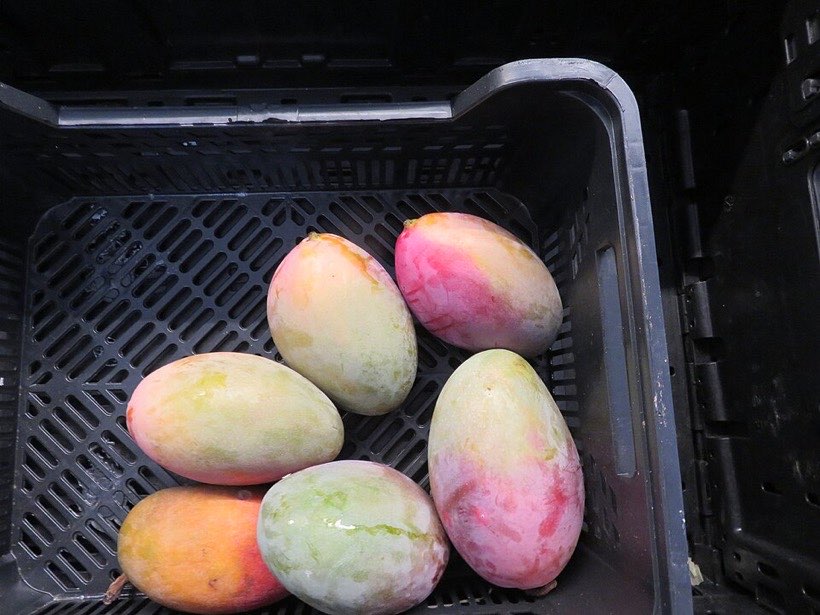
Story time: Mangoes from Rajshahi
A farmer in Rajshahi picked 852 mangoes. They are packed 6 to a crate for the trucks to Dhaka. Short division: 852 ÷ 6 = 142 crates. The next day there were 857 mangoes: 142 crates and 5 mangoes left for the family to eat!
Packing mangoes
A farmer has 852 mangoes to pack in crates of 6. How many crates? Estimate: 900 ÷ 6 = 150.
Mangoes packed in crates in Rajshahi.
Chunking
Take away 100 sixes (600), leaving 252. Take away 40 sixes (240), leaving 12. Then 2 sixes. 100 + 40 + 2 = 142 crates.
Take away big chunks of 6.
Worked example
- 468 ÷ 4 by chunking: take away 100 × 4 = 400 → 68 left.
- Take away 10 × 4 = 40 → 28 left. Take away 7 × 4 = 28 → 0.
- 100 + 10 + 7 = 117.
Short division
8 ÷ 6 = 1 r 2. Carry 2 to make 25. 25 ÷ 6 = 4 r 1. Carry 1 to make 12. 12 ÷ 6 = 2. Answer: 142.
Divide each digit, carrying the remainder.
Remainders in context
Sometimes we round up: 9 minibuses so nobody is left behind. Sometimes we round down: 100 eggs make 8 full dozens. Sometimes the remainder is the answer: 4 eggs left over.
Decide what the remainder means.
Your turn: 100 learners travel in vans of 12. How many vans are needed?
Did you know? A remainder can also be written as a fraction: 100 ÷ 12 = 8 4/12 = 8⅓.
Dividing by a 2-digit number
Take away big chunks of 16: 20 × 16 = 320. 64 is left: 4 × 16 = 64. 384 ÷ 16 = 24. Division is repeated subtraction!
Chunking works for 2-digit divisors too.
Key words
- short division
- A written method for dividing by a 1-digit number.
- dividend
- The number being divided.
- divisor
- The number you divide by.
Meet the mathematician: Liu Hui
3rd century CE · Wei kingdom, China
Liu Hui wrote notes explaining an old Chinese maths book called “The Nine Chapters on the Mathematical Art”. It included methods for division, fractions and working out areas. He showed why the methods worked, not just how to use them. He also calculated π as about 3.1416 – very close!
Activity: Fair shares
You need: base-ten blocks
- Make 365 with blocks.
- Share it equally among 5 groups, exchanging when needed.
- Record each step as short division.
- Check: 73 × 5 = 365.
Think and talk
- Which method do you prefer, chunking or short division? Why?
- When should you round a remainder up?
- How can multiplication check a division?
What I learnt
- I can divide by chunking.
- I can use short division.
- I can interpret remainders.