Grade 5 · Unit 6: Earth’s movements
The Earth rotates on its axis
One spin every 24 hours gives us day and night.
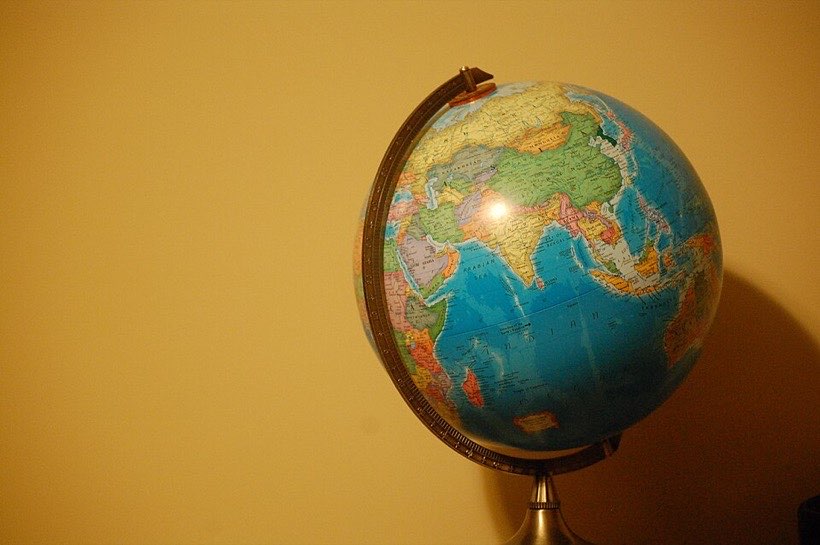
Spinning Earth
The Earth rotates (spins) on its axis. The axis is an imaginary line from the North Pole to the South Pole. One full turn takes 24 hours – one day.
The Earth spins on an imaginary line called its axis.
The axis passes through the North Pole and the South Pole. At the poles, a full day and night take the whole year!
Day and night
At any time, half of the Earth faces the Sun. It is daytime there. The other half faces away. It is night there. As the Earth spins, places move from day into night and back again.
Half the Earth is in sunlight; the other half is in darkness.
Because the Earth is round, the line between day and night is a circle. On one side people see sunrise, on the other sunset.
Which way?
The Earth spins from west to east. That is why the Sun rises in the east: places in the east turn to face the Sun first. Dhaka sees the sunrise before Delhi, and Delhi before London.
The Earth spins from west to east.
If you look down on the North Pole from space, the Earth spins anticlockwise.
A tilted axis
The Earth’s axis is tilted – it leans to one side. This tilt is why we have seasons, as you will see in lesson 6.5.
The Earth’s axis is tilted, which gives us seasons.
The Earth’s axis is tilted at about 23.5 degrees and always points the same way in space, towards the Pole Star.
Did you know? Because the Earth spins, the stars also seem to move across the sky at night.
Key words
- rotate
- Spin round.
- axis
- An imaginary line through the Earth from the North Pole to the South Pole.
- tilted
- Leaning to one side.
- day
- The time the Earth takes to spin once: 24 hours.
Activity: Globe and torch
You need: a globe or ball, a sticker for Bangladesh, a torch, a dark room
- Shine the torch at the globe.
- Find Bangladesh. Is it in day or night?
- Spin the globe slowly from west to east.
- Watch Bangladesh move into night and back into day.
- Find a country that has night when Bangladesh has day.
Think and talk
- Why is it night in some countries when it is day in Bangladesh?
- Why does the Sun rise in the east?
- Who sees the sunrise first: Dhaka or London? Why?
What I learnt
- I know that the Earth rotates on its axis once every 24 hours.
- I can explain day and night using the Earth’s rotation.