Grade 5 · Unit 3: States of matter
Evaporation
Where does a puddle go when it dries up?
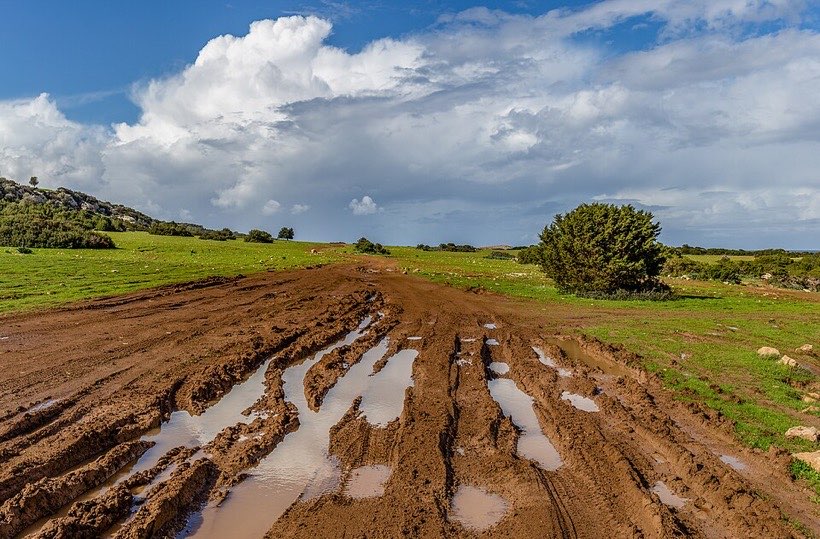
Puddles disappear
After rain, puddles slowly disappear. The water has not soaked away – much of it has turned into an invisible gas called water vapour. This change from liquid to gas is called evaporation.
After the rain stops, puddles slowly dry up in the sun.
Some of the water from a puddle also soaks into the ground, but on a hard road, evaporation does most of the work.
Escaping particles
Liquids are made of particles that are always moving. Some particles at the surface move fast enough to escape into the air. Evaporation happens at any temperature, not only when water boils.
Watch particles escape from a liquid in the States of Matter lab.
Only the fastest particles at the surface escape. Warming the liquid gives more particles enough energy to escape, so it evaporates faster.
Evaporation everywhere
Wet clothes dry on a washing line. Wet hair dries after a bath. Water in a glass slowly goes down if you leave it for many days.
Wet clothes dry on a line as the water evaporates.
Evaporation is faster when it is warm, windy and dry. That is why clothes dry quickly on a sunny, breezy day in spring.
Evaporation cools
When you sweat, the sweat evaporates from your skin. Evaporation takes heat away, so it cools you down.
Sweat evaporating from skin cools the body.
Dogs cool down by panting. Water evaporates from their tongues and mouths and carries heat away.
Did you know? A large tree can evaporate hundreds of litres of water from its leaves on a hot day.
Key words
- evaporation
- When a liquid changes into a gas at its surface.
- water vapour
- Water in the form of an invisible gas.
- surface
- The top or outside layer of something.
- particles
- The tiny pieces that all matter is made of.
Activity: Disappearing drops
You need: a dropper, water, paper towels, a stopwatch
- Put one drop of water on a paper towel in the sun and one in the shade.
- Time how long each drop takes to disappear.
- Repeat with a drop on a tile and a drop on cloth.
- Where did water evaporate fastest?
Think and talk
- Why do puddles dry faster on a sunny day?
- Where does the water from wet clothes go?
- Why do you feel cold when you get out of a swimming pool?
What I learnt
- I know that evaporation is when a liquid changes into a gas.
- I can give examples of evaporation in everyday life.