Grade 5 · Unit 1: Investigating plant growth
Seeds
A seed is a tiny plant packed with food, waiting to grow.
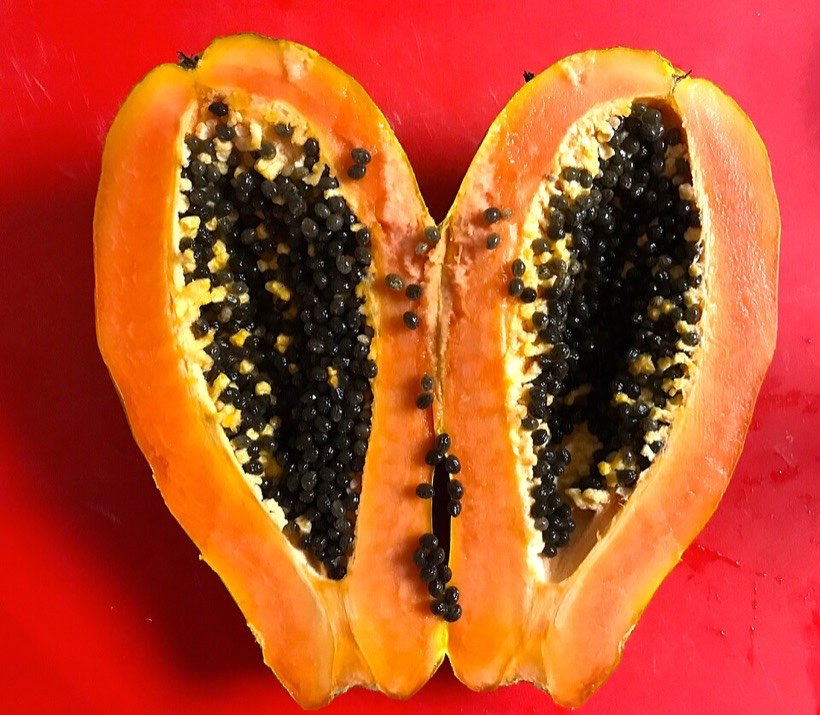
Seeds and fruits
Flowering plants make seeds inside their fruits. Some fruits, like a mango or an avocado, have one big seed. Others, like a papaya or a watermelon, have hundreds of small ones. Seeds come in many shapes, sizes and colours.
Cut a fruit open and you will usually find seeds inside.
A pea pod is a fruit too. Each pea inside is a seed. Rice grains, wheat grains and lentils are also seeds – they are a large part of the food we eat.
What is inside a seed?
Soak a bean in water overnight and carefully open it. Outside is the seed coat, a tough layer that protects the seed. Inside is a tiny plant called the embryo, and a large food store.
A bean seed opened up: the embryo and its food store.
The food store is often made of two thick seed leaves. They feed the embryo until it grows green leaves and can make its own food.
Are seeds alive?
Seeds look dead, but they are alive. While they are dry, they are dormant: alive but resting. When they get water and warmth, they wake up and start to grow.
Dry seeds can wait for months or years before they grow.
Seeds have a very tough seed coat and very little water inside them, which helps them survive for a long time without growing.
Saving seeds
Farmers keep some seeds from each harvest to plant next year. Scientists store seeds of many plants in seed banks, in case a plant is lost in the wild. Bangladesh’s rice scientists keep thousands of kinds of rice seed.
Seed banks store seeds safely so plants are never lost.
The Svalbard Global Seed Vault, deep inside a mountain near the North Pole, stores over a million kinds of seed from around the world.
Did you know? A seed of a date palm found in an ancient fortress grew into a healthy tree after about 2,000 years!
Key words
- seed
- A part of a plant that can grow into a new plant.
- seed coat
- The tough outer layer that protects a seed.
- embryo
- The tiny young plant inside a seed.
- food store
- The part of a seed that feeds the embryo until it can make its own food.
- dormant
- Alive but resting, not growing yet.
Activity: Inside a bean
You need: dried beans soaked overnight, dry beans, a magnifying glass, paper towel
- Compare a soaked bean with a dry one. What has changed?
- Gently peel off the seed coat of a soaked bean.
- Open the two halves. Find the embryo with the magnifying glass.
- Draw what you see and label the seed coat, embryo and food store.
Think and talk
- Which seeds do you eat every day?
- How can a seed be alive if it is not growing?
- Why do farmers save some of their seeds?
What I learnt
- I know that seeds are found inside fruits.
- I can name the parts of a seed: seed coat, embryo and food store.
- I know that dry seeds are dormant but alive.