Pitch on percussion instruments
Tighter, smaller and shorter make higher notes.
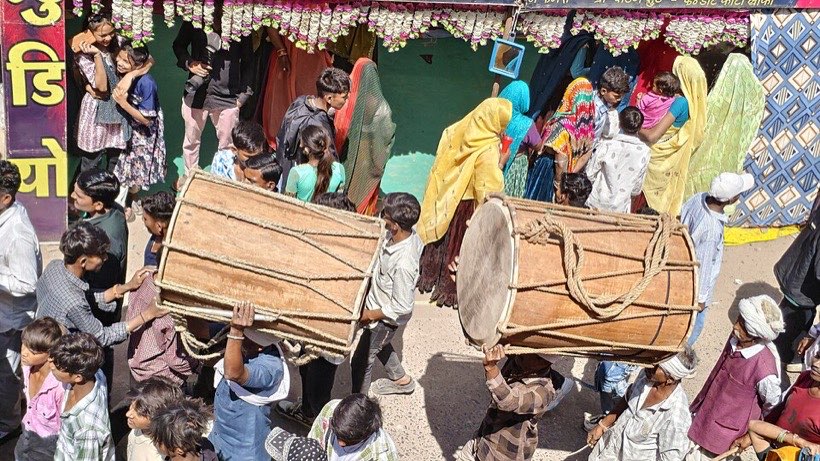
Percussion instruments
Percussion instruments are hit, shaken or scraped. Drums, tabla, cymbals, bells and shakers are percussion instruments. The dhol and the tabla are popular in Bangladesh.
The dhol is a percussion instrument played at festivals in Bangladesh.
The dhol is played with sticks on both ends. The two ends are different sizes, so one gives a deep sound and the other a sharper, higher sound.
Drums: size and tension
A small drum makes a higher sound than a big drum. Tightening the skin increases the tension. The skin vibrates faster and the pitch goes up. Tabla players tune their drums by tightening the straps.
Tabla players tighten the drum skin to tune it.
A tabla pair has a small drum (dayan) for high notes and a big drum (bayan) for deep notes. Pressing the skin while playing changes the sound.
Bars of different lengths
A xylophone has bars of different lengths. Short bars vibrate faster and make higher notes. Long bars vibrate slowly and make lower notes.
Short bars on a xylophone make high notes; long bars make low notes.
Metal xylophones are called glockenspiels. In all of them, short bars give high notes and long bars give low notes.
Water bottles
Tap bottles with different amounts of water. When you tap the glass, more water makes the vibrations slower and the note lower.
Glass bottles make different notes when tapped, depending on how much water is inside.
When you tap the glass, the glass and water vibrate together. More water makes the vibrating part heavier, so it vibrates more slowly.
Did you know? A large church bell can weigh more than a car, and makes a very deep note.
Key words
- percussion
- Instruments you hit, shake or scrape, such as drums and bells.
- tension
- How tightly something is stretched.
- xylophone
- An instrument with bars of different lengths that you hit.
Activity: Bottle xylophone
You need: 6 identical glass bottles, water, a metal spoon, a measuring jug
- Add different amounts of water to each bottle (for example 0, 100, 200, 300, 400, 500 ml).
- Tap each bottle gently with the spoon. Listen to the pitch.
- Put the bottles in order from lowest to highest note.
- Can you play a simple tune?
Think and talk
- How would you make a drum sound higher?
- Why do xylophone bars have different lengths?
- Which percussion instruments are played at festivals in your area?
What I learnt
- I know how size, length and tension change the pitch of percussion instruments.