Grade 3 · Unit 9: Laughing allowed
Limericks
There was an Old Man with a beard…
Read the limerick
Edward Lear published this limerick in 1846. Read it aloud with a bouncy rhythm.
There was an Old Man with a beard
Edward Lear, A Book of Nonsense (1846) – public domain
There was an Old Man with a beard,
Who said, “It is just as I feared! –
Two Owls and a Hen,
Four Larks and a Wren,
Have all built their nests in my beard!”
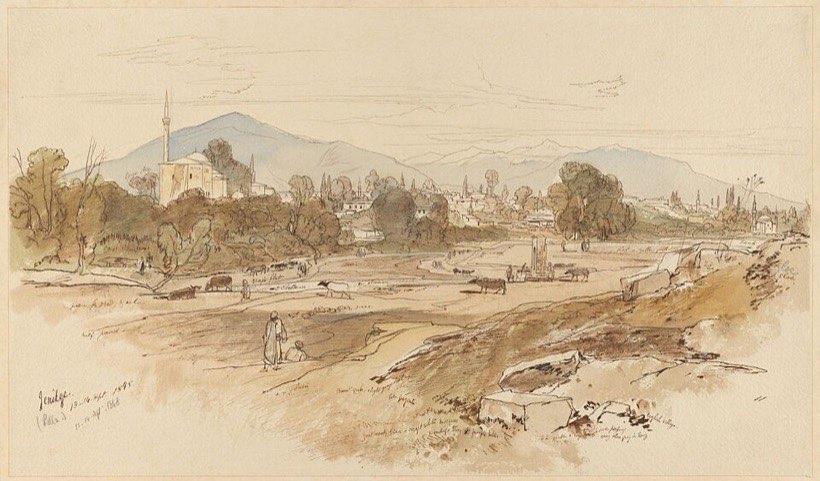
Edward Lear was also a fine artist who drew landscapes on his travels.
The limerick pattern
Lines 1, 2 and 5 rhyme and are long. Lines 3 and 4 rhyme with each other and are short. The last line is usually the funny surprise.
Limericks rhyme AABBA.
Singular and plural
Singular means one. Plural means more than one. Most nouns add -s: owls, larks. Words ending in s, x, sh, ch add -es. Some are irregular: man → men, child → children.
Most plurals add -s, but some change.
Your turn: Make plural: wren, fox, child, tooth.
Key words
- limerick
- A funny five-line poem with the rhyme pattern AABBA.
- singular
- Just one: a hen.
Meet the writer: Edward Lear
1812–1888 · London, England
Edward Lear was the twentieth child in a big family in London. He was a talented artist who painted birds, and he once gave drawing lessons to Queen Victoria. In 1846 he published A Book of Nonsense, full of funny limericks and drawings, and made the limerick famous. He also wrote The Owl and the Pussy-cat, a nonsense poem in which an owl and a cat sail away in a pea-green boat.
Activity: Write a limerick
You need: a rhyming dictionary or word list
- Start: There was a young girl from …
- Find rhymes for the place name.
- Follow AABBA with a funny last line.
- Perform it with a bouncy rhythm.
Think and talk
- How many birds are in the beard?
- Why does this poem make people laugh?
- What else could live in a beard?
What I learnt
- I can recognise the limerick pattern.
- I can use singular and plural forms correctly.